
Blog

Your Domain, Your Brand: Why Ownership Matters
Many Canberra businesses think they own their domain name when they don’t. Learn how to protect your brand and keep control of your website with

Your website might be getting visitors every day, but are those visitors actually becoming customers? Many Canberra small business owners assume that a good-looking site will naturally turn traffic into bookings or sales. The reality is more sobering. Website conversion rate measures the percentage of visitors who complete a desired action, such as a purchase, form submission, or online booking, and for most small business sites, that number is lower than you’d expect. This guide walks you through what conversion rates really mean, what’s normal, and how to steadily improve yours.
| Point | Details |
|---|---|
| Conversion rate explained | A conversion rate shows what percentage of visitors take a key action like making a booking or purchase. |
| Benchmarks for Canberra | For small businesses in Australia, a 2-4% conversion rate is typical, but the best see over 4%. |
| Quick wins matter most | Improvements like faster sites, simpler forms, and mobile-ready designs can quickly lift bookings or sales. |
| Testing and tracking | Using tools like A/B tests, heatmaps, and analytics lets you improve results without guesswork. |
| Privacy and payment options | Balancing personalisation and transparent pricing with popular payment options like BNPL boosts trust and conversions. |
A conversion happens when a visitor does what you want them to do on your site. That might be booking a service, buying a product, filling out a contact form, or signing up for a newsletter. Not all conversions are equal, though.
There are two types worth knowing:
Both matter. Micro conversions tell you how engaged visitors are before they reach the final step.
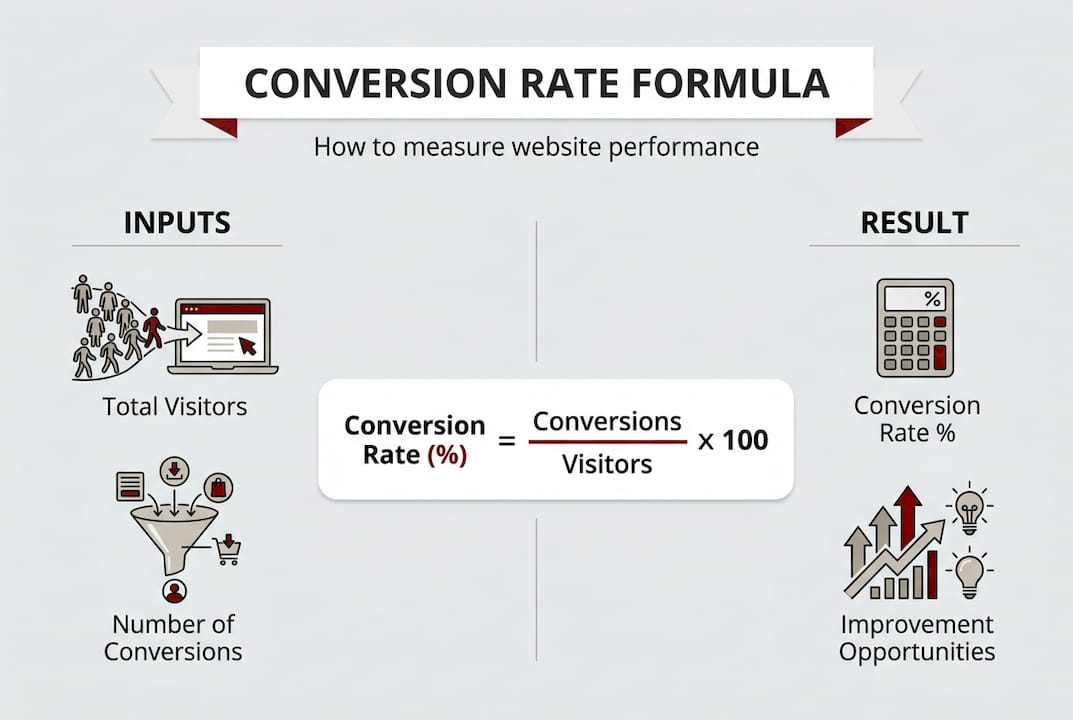
The formula is straightforward. Your conversion rate equals the number of conversions divided by total visitors, multiplied by 100. So if 1,000 people visit your site and 25 make a booking, your conversion rate is 2.5%.
| Conversion type | Example action | Why it matters |
|---|---|---|
| Macro | Completed booking or sale | Direct revenue impact |
| Micro | Clicked pricing page | Shows purchase intent |
| Micro | Newsletter sign-up | Builds long-term pipeline |
| Macro | Contact form submitted | Leads to direct sales conversation |
This metric is one of the clearest ways to measure your website’s real return on investment. Traffic numbers can look impressive, but if visitors aren’t converting, something in the experience is breaking down. Exploring business website packages designed for conversion can help you identify where your current site may be falling short.
Pro Tip: Before you try to increase traffic, focus on improving your conversion rate first. Doubling your conversions from existing visitors costs far less than doubling your ad spend.
If you’re still in the early stages, learning how to create a business website with conversion in mind from the start will save you significant rework later.
Knowing your conversion rate is one thing. Knowing whether it’s good is another. Benchmarks give you a realistic target to aim for.
Average global e-commerce conversion rates sit around 2.5 to 3%, with Australia tracking at approximately 1.78% as of late 2025 and forecasts pointing to 2 to 4% through 2026. Top-performing sites regularly exceed 4 to 5%.
| Business type | Typical conversion rate | Top performer rate |
|---|---|---|
| E-commerce (retail) | 1.5% to 3% | 4% and above |
| Service bookings | 2% to 5% | 6% and above |
| B2B / consulting | 1% to 2% | 3% and above |
| Local services (Canberra) | 2% to 4% | 5% and above |
These figures vary significantly by industry. A local Canberra tradie or beauty salon accepting online bookings will naturally see different numbers than a national e-commerce retailer. The key is to compare your site against businesses in a similar category, not against a generic average.
One important caution: a high conversion rate doesn’t always mean high profit. If you’re converting well on low-margin products, the numbers can look good while your bottom line suffers. Always read conversion data alongside revenue figures.
Reviewing website design tips specific to Canberra businesses can help you understand which design choices are actually moving the needle locally. And if budget is a concern, affordable website services exist that don’t require you to sacrifice quality for cost.
Understanding benchmarks is just the start. What actually causes visitors to convert, or to leave without acting?

Best practices for conversion consistently point to the same factors: mobile optimisation, thumb-friendly calls-to-action, page loading under 2.5 seconds, guest checkout options, autofill support, clear value communication, social proof, and urgency cues.
Here’s what tends to block conversions for Canberra small businesses:
“Small, steady improvements to your site’s user experience often deliver bigger conversion gains than a complete redesign.”
Pro Tip: Test your own booking or checkout process on a mobile phone right now. Count every tap required to complete the action. If it takes more than five steps, you’re likely losing customers at each one.
Reviewing Canberra website design tips can help you prioritise which changes to make first. For hosting-related slowdowns, professional hosting advice explains why your server environment matters more than most people realise. You can also find practical guidance on faster site performance to address load time issues directly.
Once you understand what’s holding your site back, you can start making deliberate improvements. This process is called conversion rate optimisation, or CRO.
Key CRO methods include A/B testing, heatmaps, and prioritising revenue per user rather than chasing a higher conversion rate at any cost.
Here’s a practical sequence to follow:
Common mistakes to avoid:
“Chasing a higher conversion rate without watching your margins is like filling a leaky bucket. The number goes up, but the business doesn’t.”
Pro Tip: If your site gets fewer than 1,000 visitors per month, standard A/B testing won’t give you reliable results. Focus on qualitative feedback, such as customer interviews or usability sessions, instead.
Looking at Canberra e-commerce examples can give you a clearer picture of what works locally. And if your site lacks a clear path to purchase, that’s often the single biggest conversion barrier to fix first.
Beyond the fundamentals, there are more advanced levers you can pull to lift your conversion rate. Personalisation, pricing strategy, and payment options all play a role.
Personalisation can backfire if overdone, dynamic pricing works when it’s transparent, and BNPL adoption at 21% among Australian online shoppers can meaningfully aid conversions when integrated well.
Here’s what to consider:
For a deeper look at conversion optimisation nuances, real-world examples can show how these techniques play out in practice.
Pro Tip: If you’re adding BNPL to your site, display it prominently on product and booking pages, not just at checkout. Seeing the option early reduces price hesitation before it becomes a barrier.
Exploring WordPress customisation examples for Canberra businesses can show you how these features are implemented practically without requiring a large technical investment.
Reading about conversion rate optimisation is useful. Applying it to your specific site, audience, and business goals is where the real work happens, and that’s where having a local partner makes a genuine difference.
At Asporea Digital, we build WordPress websites specifically for Canberra small businesses, with conversion built into the design from the start. Whether you need a streamlined booking system, a WooCommerce store that reduces cart abandonment, or a site that loads fast and looks professional on every device, we focus on outcomes, not just aesthetics. Our WordPress customisation work for Canberra businesses shows what’s possible at a fixed, affordable price. If you’re ready to see how your site could perform better, explore our WooCommerce guide for Canberra or book a free strategy call with our team today.
Divide your total conversions, such as bookings or sales, by your total visitors, then multiply by 100. So 30 bookings from 1,000 visitors gives you a 3% conversion rate.
For most small business sites, rates between 2% and 4% are typical. Top performers regularly exceed 4 to 5%, particularly in service-based industries with strong local trust signals.
Speed up your site, simplify your booking or checkout process, and make your call-to-action impossible to miss. Mobile optimisation and clear value communication deliver results faster than most other changes.
Yes, if you have sufficient traffic. For lower-traffic sites, multivariate or sequential testing is more reliable than standard A/B testing, which needs volume to produce meaningful results.
It can, particularly in Australia where 21% of online shoppers used BNPL in 2025. Displaying it early in the purchase journey, not just at checkout, tends to have the strongest effect.

Many Canberra businesses think they own their domain name when they don’t. Learn how to protect your brand and keep control of your website with

Discover 10 essential questions to ask before building a membership website, from content readiness to value and retention.
As email lists grow, pricing increases and platforms become harder to use, even though the work stays the same. This article looks at why that