
Blog

Why Clubs Are Moving Membership Renewals Online
Clubs are moving membership renewals online to reduce admin, free up front desk staff and make dues, payments and member updates easier to manage.

Website revenue generation is the process of converting website traffic and visitor engagement into consistent income through multiple monetisation methods. For individuals and small business owners, this is not a passive outcome. It requires deliberate choices about which methods suit your audience, your traffic level, and your goals. The most common approaches include display advertising through networks like Google AdSense, affiliate marketing, selling digital products or services, and subscription models. Getting this right means diversifying across streams rather than relying on a single source, which leaves your income exposed to sudden drops.
Website monetisation is the process of converting traffic into revenue using methods like display ads, affiliate marketing, subscriptions, and product sales. Each method works differently depending on your site’s size, niche, and the relationship you have built with your readers.
Display advertising pays you based on impressions (CPM) or clicks (CPC). Google AdSense is the most accessible entry point for beginners. You place ad code on your site, and advertisers bid to show their ads to your visitors. The income is passive once set up, but it scales with traffic volume. A site with a few hundred monthly visitors will earn very little from display ads alone.

Affiliate marketing is often the highest leverage monetisation method because it taps into purchase intent. You recommend a product or service, include a tracked link, and earn a commission when a reader buys. Sites with 10,000 monthly visitors can earn hundreds to several thousand dollars monthly with well-matched affiliate offers. The key word is “well-matched.” Recommending accounting software to a cooking blog produces almost nothing. Recommending it to a small business advice site produces real income.
Selling your own digital products, such as templates, guides, online courses, or consulting packages, produces the highest margins of any monetisation method. There are no commissions paid to a third party. A single well-priced product can generate more income than months of display ad revenue. For service businesses, this might mean selling a paid discovery session, a downloadable checklist, or a structured coaching programme.
Sponsored content involves a brand paying you a flat fee to feature their product or service in your content. This differs from pay-per-impression advertising because the fee is agreed upfront. Sponsorships work across traffic levels if your audience is targeted and relevant to the sponsor. A niche Canberra business blog with 2,000 loyal readers can attract local sponsors more easily than a generic site with 20,000 disengaged visitors.
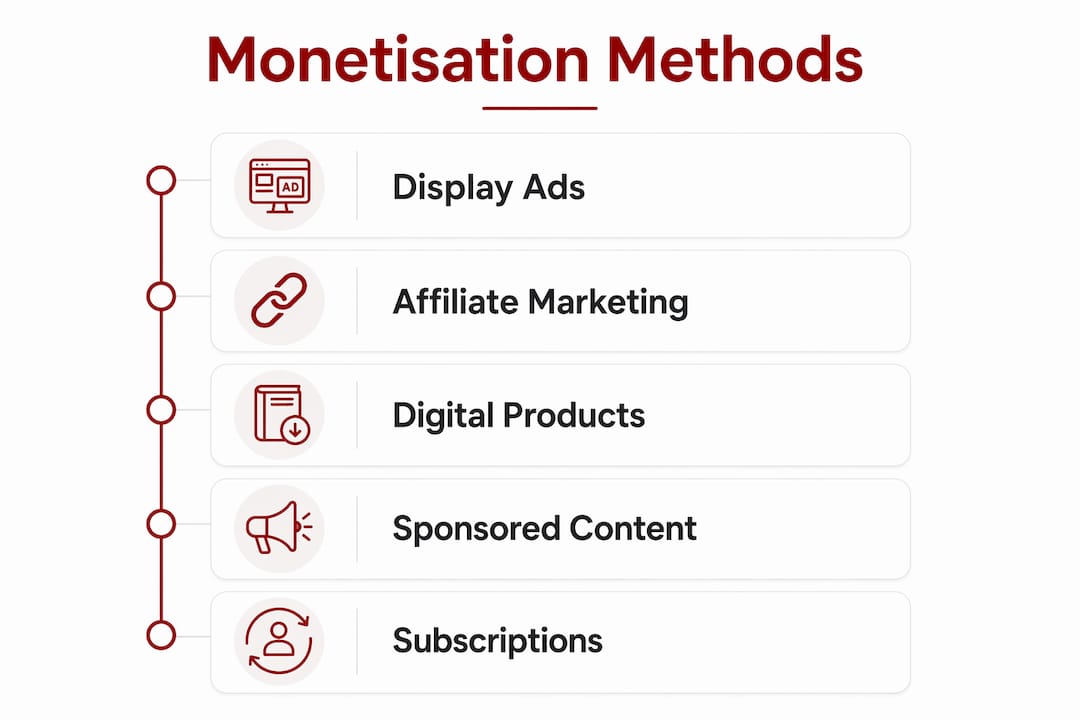
Recurring revenue via paid memberships and subscriptions offers more predictable income than one-off sales or ad clicks. Subscription models convert casual visitors into committed communities. This suits sites that produce regular, high-value content, such as industry newsletters, professional development resources, or member-only tools. You can explore membership site ideas that work specifically for small businesses looking to build recurring income.
Pro Tip: Start with one or two monetisation methods that match your current traffic and audience trust. Adding too many streams too early creates a cluttered experience that erodes reader confidence.
Monetisation success depends more on your audience relationship than on traffic volume alone. This is the principle that separates sites that earn well from sites that earn nothing despite decent visitor numbers.
A small but engaged audience is more valuable than a large, indifferent one. Small, loyal traffic sites benefit from selling high-ticket services or digital products over display advertising. Display ads require massive, broad-interest traffic for significant returns. If your site attracts 1,000 readers a month who trust your recommendations, a single $500 consulting package or a $97 digital guide will outperform months of AdSense income.
Once your site reaches meaningful traffic volume, display advertising and affiliate marketing become genuinely worthwhile. At this scale, you can also attract direct sponsors and negotiate better affiliate commission rates. The features of effective service websites matter here too. A site that loads quickly, presents content clearly, and guides visitors toward a clear action will convert traffic into income far more reliably than one that looks cluttered or loads slowly.
Affiliate marketing success depends heavily on niche alignment. A financial planning site recommending accounting tools earns well because the audience has clear purchase intent. The same site recommending fitness equipment earns almost nothing. Matching your affiliate offers to your content topic is not optional. It is the difference between a meaningful income stream and wasted effort.
Pro Tip: Before adding any monetisation method, ask yourself: “Would my readers thank me for this, or would they feel sold to?” If the answer is the latter, the method is wrong for your audience at this stage.
Growing your audience is the foundation of any revenue model. Practical strategies for increasing website traffic for small businesses give you the visitor numbers that make monetisation worthwhile.
Website speed and uptime are foundational revenue infrastructure. Poor performance reduces monetisation effectiveness directly. Slow loading reduces engagement, increases bounce rates, and harms search rankings. Lower rankings mean less organic traffic, which means less revenue regardless of which monetisation method you use.
The table below compares traditional waterfall ad setups with header bidding technology.
| Feature | Traditional waterfall | Header bidding |
|---|---|---|
| How bids work | Ad networks bid one at a time in sequence | Multiple ad exchanges bid simultaneously |
| CPM outcome | Lower, as early bids often win by default | Higher, due to genuine competition |
| Revenue uplift | Baseline | CPM increase of 20–50% over waterfall |
| Setup complexity | Simple, suitable for beginners | More complex, often requires technical help |
| Best suited for | New sites testing display ads | Established sites with consistent traffic |
Header bidding lets multiple ad exchanges bid at the same time, which creates real competition for your ad inventory. That competition drives up the price advertisers pay. Header bidding technology involves a more complex setup but yields significantly better CPMs and revenue stability. For sites earning meaningful display ad income, this technical integration shifts the site from a side project to a serious revenue source.
You do not need to implement header bidding on day one. Start with the basics. Use a fast, reliable hosting provider. Compress images before uploading them. Use a caching plugin if your site runs on WordPress. Fix broken links and remove unused plugins that slow page load times. These steps improve both user experience and search rankings, which feeds directly into your ability to earn.
Optimising ad technology is as critical as content quality for maximising revenue. Many site owners focus entirely on content and ignore the technical stack. Both matter equally once you reach a meaningful traffic level.
Pro Tip: Check your site’s load time using Google PageSpeed Insights. A score below 70 on mobile is costing you visitors and income. Fix the biggest issues first before adding any monetisation layer.
Most successful web publishers diversify monetisation with multiple revenue streams to reduce risk. Reliance on a single source risks rapid income loss if that source changes its terms, reduces payouts, or disappears entirely. Here is a practical sequence for individuals and small business owners.
Add display advertising first for immediate, passive income. Sign up for Google AdSense or a similar network. Place ads in high-visibility locations such as above the fold and within content. This generates income from day one, even if modest, and gives you a baseline to measure against.
Identify two or three affiliate programmes that match your content. Look for products or services your readers already use or ask about. Apply to their affiliate programmes and add tracked links within relevant content. Review your affiliate earnings monthly and replace underperforming offers with better-matched alternatives.
Develop one digital product or service offer. This could be a downloadable guide, a template pack, an online course, or a paid consultation. Price it based on the value it delivers, not the time it took to create. A well-positioned $149 guide can outsell a $9 ebook ten times over if it solves a specific, urgent problem.
Build a recurring revenue stream. A paid newsletter, a members-only resource library, or a monthly coaching group all create predictable income. Even a small subscriber base paying $15 per month creates a reliable foundation. Review ecommerce options if you plan to sell physical or digital products at scale.
Measure results and cut what is not working. Use Google Analytics or a similar tool to track which pages generate the most revenue. Double down on what works. Remove or rework monetisation placements that generate no income after 90 days. Scaling effective streams is more productive than adding new ones before the existing ones are working.
Diversify to protect your income. Running two or three income streams simultaneously means one underperforming stream does not collapse your total revenue. This is the single most consistent habit of sites that earn reliably over the long term.
For small business owners managing finances alongside their website, understanding cost-saving accounting strategies helps ensure that revenue earned online translates into real profit rather than being absorbed by avoidable costs.
Website revenue generation works best when you match your monetisation method to your audience’s trust level and your site’s traffic volume, then diversify across two or three income streams for stability.
| Point | Details |
|---|---|
| Define your revenue model early | Match your monetisation method to your current traffic size and audience relationship. |
| Affiliate marketing offers high leverage | Sites with 10,000 monthly visitors can earn hundreds to thousands of dollars with well-matched offers. |
| Technical performance affects earnings | Slow sites lose visitors and rankings, which directly reduces every monetisation method’s effectiveness. |
| Header bidding lifts ad income | Simultaneous bidding from multiple exchanges can increase CPMs by 20–50% over traditional setups. |
| Diversification reduces income risk | Running two or three revenue streams protects against sudden drops from any single source. |
A website that earns income needs more than good content. It needs fast load times, clear conversion paths, and a structure that supports the monetisation methods you choose.
Asporeadigital builds fixed-price WordPress and WooCommerce websites for small businesses in Canberra and the Capital Territory, designed around business outcomes rather than aesthetics alone. Whether you need a site that supports WooCommerce product sales, affiliate content, or a membership model, Asporeadigital scopes the project clearly and builds it to perform. The team also handles hosting, maintenance, and ongoing support through Asporea Hosting, so your site stays fast, secure, and ready to earn. If you want a website built to support real revenue growth, WordPress digital marketing guidance from Asporeadigital is a practical starting point.
Website revenue generation is the process of converting website traffic into income through methods such as display advertising, affiliate marketing, product sales, and subscriptions. Successful sites typically diversify across 2–3 streams to maximise stability and profit.
Display advertising requires high traffic volumes for meaningful returns, but affiliate marketing and digital product sales can generate income from a small, loyal audience. A site with 1,000 engaged monthly visitors can earn more from a well-priced digital product than from display ads alone.
Affiliate marketing or selling a digital product or service suits new sites better than display advertising. Beginners should avoid starting with display ads on low-traffic sites, as the returns are negligible until traffic reaches a meaningful scale.
Yes. Slow loading directly impacts user engagement and search rankings, which reduces traffic and weakens every monetisation method on your site. Fixing speed issues is one of the highest-return technical investments you can make.
Header bidding is a technology that lets multiple ad exchanges bid simultaneously for your ad inventory, which increases competition and lifts CPMs. It matters most for established sites with consistent traffic. Small sites should focus on content and audience growth before implementing header bidding.

Clubs are moving membership renewals online to reduce admin, free up front desk staff and make dues, payments and member updates easier to manage.

DIY Squarespace can look cheap, but hidden costs, owner time and growth limits can make WordPress the smarter long-term choice.

Substack is easy to launch, but paid publishing needs strategy. Shape the content, offer and member journey before adding a paywall.