Blog

Stop Guessing: The Three Metrics Your Website Should Tell You Every Week
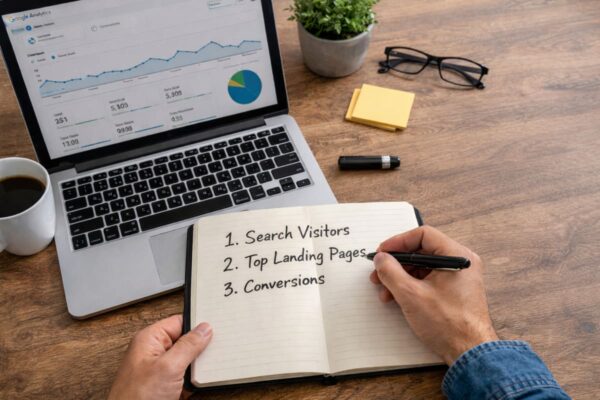
Track search metrics like visitors, landing pages and enquiries weekly so you can see what’s working and what to fix next.

TL;DR:
- Your website should actively attract and convert prospects rather than just display static information.
- Optimizing speed, minimizing form fields, and using clear calls to action significantly boost client acquisition and engagement.
Your website is doing more work than you probably realise. Or it should be. The role of website in client acquisition has shifted dramatically over the past few years. A site that once served as a digital brochure now has the potential to be your most reliable source of new enquiries, bookings, and sales. Yet most small business websites still behave like static information pages. They list services, show a phone number, and wait. That passive approach leaves a lot of business on the table, and this guide will show you exactly what to do instead.
| Point | Details |
|---|---|
| Websites drive active acquisition | A well-built site works continuously to attract, engage, and convert prospects into clients. |
| Speed directly affects conversions | A one-second load delay can reduce conversions by around 7%, hitting small businesses hardest. |
| Simpler forms convert better | Lead capture forms with 3 to 5 fields consistently outperform longer forms by a significant margin. |
| AI search sends better leads | Traffic from AI-powered search tools converts up to nine times higher than traditional organic search. |
| Measure and adjust regularly | Tracking key metrics and making steady improvements is what separates growing sites from stagnant ones. |
Think of your website as your best salesperson. It is available at any hour, does not take sick days, and can speak to dozens of potential clients at once. The role of online presence in business has never been more direct or more measurable. Every page your prospect visits, every form they fill in, and every booking they make traces back to decisions you made about your website.
Your site is also the anchor point for everything else you do online. Social media posts lead back to it. Google search results point to it. Email campaigns drive people toward it. Without a strong, well-built website, every other marketing effort you invest in loses effectiveness quickly.
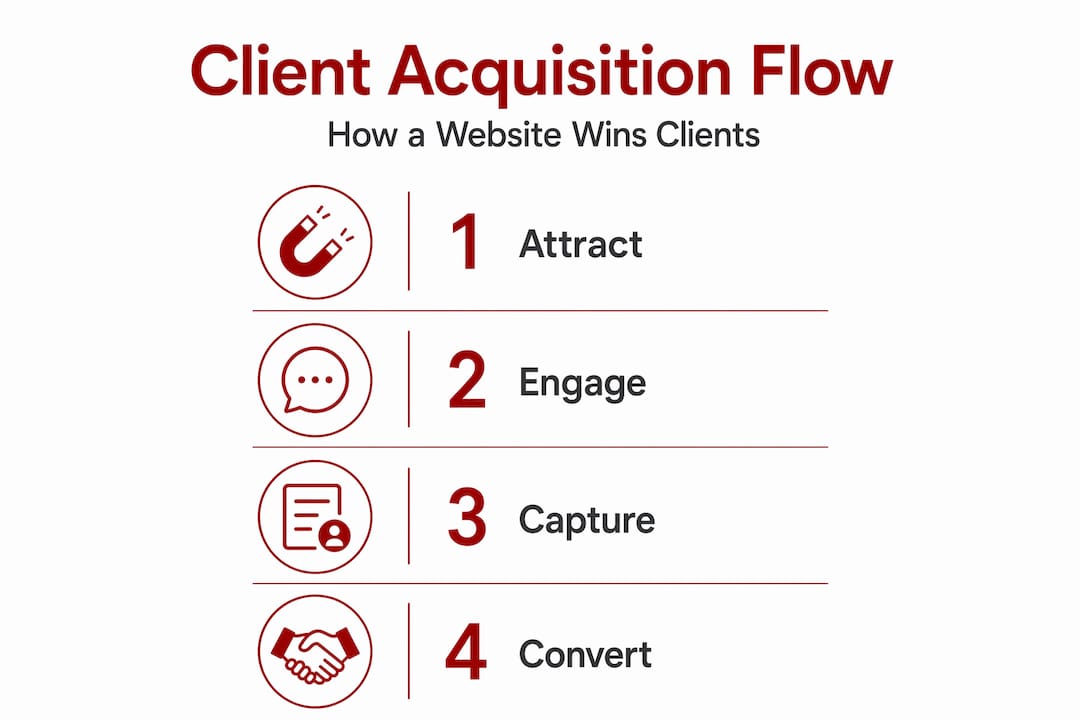
Here is what a website that actively drives client acquisition actually does for you:
Website effectiveness in sales is not accidental. It comes from deliberate choices about structure, content, and user experience. The businesses that understand this treat their website as an investment, not a cost.
Good design is not about looking attractive. It is about removing friction between a potential client and the decision to contact you. Every element on your site either helps or hurts that process.
A one-second delay in page load time reduces conversions by around 7%. For a small service business generating enquiries through its website, that is a meaningful number. Importantly, speed benefits growing businesses most. Established brands with loyal audiences can absorb slow load times more easily. If you are still building your client base, a fast, well-optimised site is one of your strongest competitive advantages.

Pro Tip: Use Google’s free PageSpeed Insights tool to test your site today. A score below 70 on mobile is worth addressing before anything else.
Most business websites ask for too much information too soon. Research shows that 3 to 5 field forms consistently outperform longer ones, with short forms achieving roughly 25% conversion compared to around 15% for six-field versions. Ask only what you genuinely need at the first point of contact. Name, email, and a brief description of what the person needs is usually enough to start a conversation.
Generic labels like “Submit” or “Contact Us” do very little heavy lifting. Personalised CTAs convert at 202% better than default button text. Think about what your prospect is actually hoping to do. “Book a free 20-minute call” or “Get my quote today” speaks directly to the outcome they want, which makes clicking feel easy and natural.
Once someone completes a contact form, the follow-up process often loses momentum. Calendar integration on thank-you pages allows a prospect to book a time immediately rather than waiting for your reply. This removes the back-and-forth that cools interest and speeds up the entire sales cycle. For service providers particularly, this one change can noticeably improve how many enquiries convert to actual consultations.
The following table compares passive and active website approaches across key client acquisition elements:
| Element | Passive website | Active, acquisition-focused website |
|---|---|---|
| Contact option | Email address listed on page | Embedded form with 3 to 4 fields and clear CTA |
| Load speed | Often untested and slow | Optimised, regularly monitored |
| Booking process | “Call us to arrange a time” | Live calendar booking on contact and thank-you pages |
| Content | Generic service descriptions | Specific, audience-relevant answers to client questions |
| CTAs | “Submit” or “Contact Us” | “Book your free consult” or “Get your quote today” |
The way people search for services is changing, and your website needs to keep pace. Modern search behaviour, shaped by AI tools and intelligent query filtering, means the traffic reaching your site today is increasingly purposeful. Visitors who arrive via AI-assisted search have often already narrowed down their options. They are looking for confirmation, not discovery.
AI-driven search traffic converts up to nine times higher than traditional organic search. That is a substantial shift in lead quality. The implication for your website is straightforward: if your content answers specific, high-intent questions clearly and with genuine depth, you attract visitors who are far closer to making a decision.
This connects directly to content strategy. Unique, in-depth content is now critical for visibility in AI-powered search environments. Thin, generic pages get filtered out. Pages that demonstrate genuine expertise and answer real client questions get surfaced and read.
Paid search is also evolving. Brands using AI-assisted search campaigns report around 14% more conversions at similar cost per acquisition. This reinforces the value of pairing strong organic content with well-structured paid activity.
There are several practical implications worth keeping in mind:
“Modern websites must operate as performance engines, not passive brochures. Integrating AI signals, first-party data, and multi-channel engagement is what turns site traffic into sustained client acquisition.”
The businesses that adapt their websites to this reality now will find client engagement through websites much easier to sustain over the next few years.
You cannot improve what you do not track. The good news is that monitoring your website’s contribution to client acquisition does not require advanced technical knowledge. A few consistent habits go a long way.
Track load time monthly. Use a free tool like PageSpeed Insights or GTmetrix. A site that was fast six months ago may have slowed down after a plugin update or new content addition. For growing businesses, site speed and conversion rates remain closely linked.
Monitor form completion rates. If you have Google Analytics or a similar tool installed, check how many people reach your contact form versus how many actually submit it. A large drop-off suggests the form is too long, confusing, or appearing at the wrong point in the user journey.
Check CTA click-through rates. Each call to action on your site should be trackable. Low click rates usually mean the label is too vague or the placement is poor. Experiment with wording and position before assuming the page itself is the problem.
Implement partial submission capture. Partial form submission technology can recover leads from visitors who started filling in your form but did not complete it. This alone can lift lead conversion by more than 10%. It is one of the more underused tactics in small business digital marketing for client acquisition.
Review your highest-traffic pages quarterly. Look at which pages bring visitors in and whether those pages have a clear next step. A page that attracts traffic but has no lead capture mechanism is a missed opportunity every single time.
Pro Tip: Set a recurring calendar reminder each quarter to review your top five pages. Check load speed, CTA placement, and form completion. Small, steady adjustments over time create a noticeably stronger client acquisition funnel.
I have worked with enough Canberra small businesses to notice a consistent pattern. The website gets built, it looks decent at launch, and then nobody touches it for two years. The business owner assumes that having a website is enough. It rarely is.
What I have found is that the gap between a website that exists and a website that actively works is not about budget or complexity. It is about intent. When a site is designed around what the client needs to see and feel in order to make contact, the results are different. Simple things: a fast load, a short form, a direct CTA, a booking option. They add up.
I have also seen businesses spend significant money on digital advertising only to send that traffic to a slow, unclear website with no real conversion path. The ads were fine. The website was the problem. How website design shapes client trust is something I come back to with almost every client, because trust is what converts a curious visitor into an enquiry.
My honest advice is this: before you spend another dollar on marketing, look at your website the way a stranger would. Does it load quickly? Is it clear what you do and who you help? Is there an obvious, easy next step? If the answer to any of those is no, that is where your attention belongs first.
— James
If this article has prompted you to look more critically at your own site, that is a good starting point. Understanding the role of website in client acquisition is one thing. Doing something about it is another.
Asporea Digital builds fixed-price WordPress websites for small businesses in Canberra and the surrounding region, designed specifically to attract enquiries, support bookings, and build the kind of trust that turns visitors into clients. Whether you need a smart web design that drives sales, a better understanding of WordPress for digital marketing growth, or simply a site that loads quickly and works properly on mobile, the team at Asporea Digital can help. Every project is scoped clearly, built around your business outcomes, and supported by a local team you can actually reach. Get in touch to talk through what your website could be doing better.
Your website acts as the central hub for attracting, engaging, and converting prospects into clients. It supports every other marketing channel and is often the last thing a potential client reviews before making contact.
A one-second delay in page load time reduces conversions by around 7%. For small and growing businesses, fast-loading sites have a direct and measurable impact on how many visitors become leads.
Forms with 3 to 5 fields consistently outperform longer versions. Short forms reduce friction and can achieve conversion rates close to 25%, compared to roughly 15% for forms with six or more fields.
AI-powered search filters out low-intent queries, sending more qualified visitors to your site. This traffic converts up to nine times better than traditional organic search, which means your content needs to answer specific, high-intent questions clearly.
Focus on page load speed, contact form completion rates, CTA click-through rates, and overall lead volume. Reviewing these consistently each quarter gives you a clear picture of where your site is working and where it needs attention.

Track search metrics like visitors, landing pages and enquiries weekly so you can see what’s working and what to fix next.

Learn how clearer expectations, ownership and communication build a better website relationship.

Build your online profile early to turn experience into coaching, courses, mentoring and new income before you need it fast.