
News

Googong Connect: A Smarter, Friendlier Way to Build Community
Discover Googong Connect, a new platform bringing residents, businesses and community groups together. Connecting everyone from 2026.

Substack makes publishing look deceptively simple.
You can write a post, send it to subscribers, charge for access, and avoid much of the technical work that used to sit behind paid publishing. You do not need to build a custom website first. You do not need to configure a separate email platform or payment gateway before you test an idea.
For writers, consultants, educators and small business owners, that is genuinely useful, but it also creates a problem.
Because the platform is easy to use, people often skip the harder commercial thinking. They launch the publication, add a paid tier, lock a few posts, and assume the model will work because the mechanics are there. But a paywall is not a strategy. It is only a boundary. A paid Substack works when readers understand the value of the publication, see a clear reason to subscribe, and want to stay subscribed.
This is why content strategy matters because it’s the commercial logic behind the publishing.
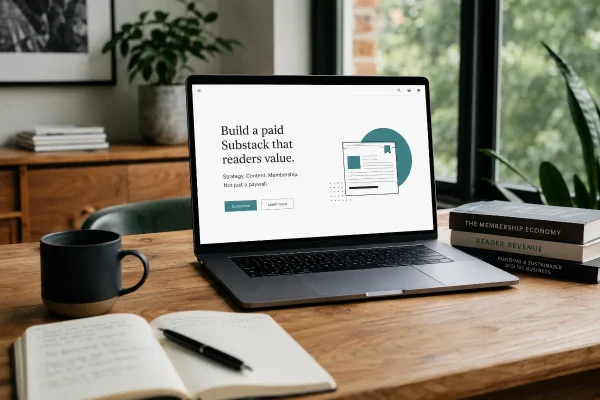
If you currently have a free newsletter you can afford to wander a little. You can test ideas, build familiarity, and let readers get used to the your thinking. The looseness can be part of your appeal. People can subscribe, read occasionally, and decide whether the perspectives are useful to them – and there’s no risk because no money is changing hands.
A paid publication has less room for vagueness.
When someone pays for a subscription, they are deciding that this publication gives them something worth returning to, not just something worth sampling. It could help them make better decisions, interpret a subject more clearly, access resources they can actually use, or feel connected to a broader conversation or content than they hear about in the mainstream.
It’s neither about more posts or exclusive content. If your content is thin or forgettable then it lacks the value that keeps people subscribing. A post does not become valuable because it is locked but because the subscriber can see how it helps, and why it belongs inside the paid relationship rather than the free one.
Many paid Substacks fall down because the paid offer still does not give the reader enough to hold onto. The publication asks for money before it has made the subscription feel valuable.
Your content strategy is the thinking that connects your audience, the offer, the content and the business model. It crystallises who the publication is for, what the reader should get from it, what the free material needs to establish, what paid subscribers receive, and how the Substack fits into the rest of your business model.
That last point matters more than people expect.
For some creators, Substack is the product – in other words the paid newsletter is the whole offer, and the subscriber relationship lives almost entirely inside the platform. For others, Substack is one part of a larger model.
A consultant might use it to build trust before a client enquiry. An educator might use it to support a course. A professional services business might use it to develop a paid resource library, membership site, or advisory community.
Those models require different content decisions.
A Substack designed to generate consulting leads should not be built the same way as a standalone paid publication. A Substack connected to a membership website needs a different structure again, because the newsletter and the website need to know what each is responsible for. If that is not clear, the reader can end up with a muddled experience where the same ideas appear in multiple places, the paid area feels bolted on, and the offer becomes harder to explain.
The content is part of the commercial model, not divorced from it.
Often people will ask me, “What should we put behind the paywall?”
It feels like a natural place to start, because it determines whether people will pay. But that shouldn’t be your first question.
The better question is what will make your reader trust what you write enough to subscribe – and what would make them keep that paid subscription to keep reading. When you ask this question it moves the conversation away from hiding content and towards building right relationship with your readers that supports payments.
Free content should not be treated as leftovers – it is a robust demonstration of the way you think, and your judgement. It should be used to help readers see that what you write is relevant to them. If your free content isn’t creating this level of reader confidence then you may have already lost your paying audience.
Paid content must be more useful than your free content. That might mean deeper analysis, practical application, member resources, implementation notes, regular briefings, or access to a more focused discussion. The right answer here depends of course on the audience and the offer.
A consultant writing for business owners will draw the line differently from a journalist writing for policy professionals. A creator building a community will make different choices from a specialist selling access to templates, briefings or training material.
There is no universal free-paid split. There is only the split that makes sense for the subscriber and the business model.
A visitor should not have to work hard to understand what they are being asked to pay for. This is one of the simplest tests of a paid publication, and one many fail.
Phrases such as “weekly reflections”, “premium updates” and “exclusive insights” might describe the format, but they do not explain the benefit. They leave the reader with the work of translating the offer into something useful. Most readers will not do that work, especially if they have only just discovered the publication.
A stronger offer tells the reader what the subscription helps them do, understand, access or keep up with. it’s about describing and demonstrating the value. If the publication helps independent consultants price their work more confidently, say that. If it gives members practical resources for running change programmes, say that. If it helps business owners understand what to do before building a membership website, say that.
The offer should be specific enough that the right reader can recognise themselves in it.
If the Substack is for everyone, the paid proposition will usually feel weak. A paid subscription needs enough definition to make someone think, “Yes, this is for people like me, dealing with the kind of thing I care about.”
A subscription is not a one-off sale, so the publication needs more than a launch idea. The reader is paying for value over time. They need some sense of what will arrive, why it is useful, and how it fits into the promise of the publication.
That does not mean publishing constantly.
Constant publishing can become noise, and noise is not a retention strategy. The rhythm might be a weekly essay, a monthly briefing, a recurring Q&A, a set of practical resources, a case-based note, or a member-only commentary series. The format matters less than the expectation it creates.
That rhythm also has to be sustainable for you as the publisher.
Many paid publications are planned around launch energy, which is a dangerous base to build on. At launch, the author is motivated, the idea feels fresh, and the first few posts are usually already half-formed. Three months later, client work, delivery, sales, admin and ordinary life have returned. If the publishing rhythm depends on heroic effort, it will probably break.
A realistic content strategy asks what can be maintained without eroding the quality of the work. It is better to have a rhythm that can survive a busy month than a grand publishing plan that collapses after the announcement period.
The first subscription is not the proof that the model works. It may only prove that someone was curious, supportive, or interested enough to try it. The harder proof is whether they stay.
A paid Substack has to keep earning its place. After the first few issues, the subscriber has a clearer sense of whether the publication is useful to them. They know whether they open it. They know whether it saves them time, gives them language for something they are dealing with, helps them make sense of a problem, or gives them access to something they would miss if it disappeared.
If the value is not obvious, people cancel quietly. They usually do not send a detailed explanation. They just stop paying.
That is why retention has to be considered before launch, not after cancellations start appearing. A paid publication needs a view of why the subscription will still matter in the second month, the sixth month and at renewal. Not a rigid content machine, but a clear sense of how the publication continues to earn attention after the novelty has gone.
Substack can work well as a complete paid publication. For some creators, that is the right model. The writing, subscriber relationship, payment and delivery all happen in one place, and there is no need to complicate it.
For consultants, educators, niche experts and professional service businesses, Substack may be better used as the front end of a larger subscription or membership offer. The newsletter builds the relationship, while the website holds the deeper member experience. That might include a resource library, course material, templates, private recordings, event access, member-only pages or structured advisory content.
This distinction matters because it changes what Substack should do. If Substack is the full product, the publication has to carry the whole member experience. If Substack is feeding a membership website, it may need to focus more on trust, interpretation, engagement and moving the right people into the paid environment.
Building the wrong model creates friction. Subscribers do not know where the value lives. The website and newsletter repeat each other. The paid area feels bolted on. The offer becomes harder to explain. That is not a technology issue. It is a structure issue.
People do not usually arrive at a paid Substack cold and subscribe immediately. They may see a LinkedIn post, read a shared article, visit the author’s website, hear about the publication from someone else, or come through an existing client relationship. By the time they see the subscribe button, they have already formed an impression.
The publication name, description, author profile, article formatting, welcome message, paid tier explanation and website connection all affect that impression. If the LinkedIn presence says one thing, the website says another, and the Substack offer feels like a third idea, the reader has to do the work of joining it all together.
Most people will not bother.
A good reader journey rmakes the offer easier to understand, the author easier to trust, and the next step clear for them to take. This is where design matters, but not in the superficial sense of choosing a nicer banner. Design, in this context, is about shaping how the offer is presented, how the content is organised, and how a reader moves from interest to trust to subscription.
A poorly shaped Substack does not always look broken.
The publication description may be too broad, so the right reader does not feel addressed. The free posts may be interesting, but they do not build a reason to subscribe. The paid tier may offer more content, but not a clearer benefit. The author may have real credibility, while the Substack fails to make that credibility easy to see.
The same thing happens when the publishing rhythm depends on energy the author will not have every month, or when the website, services, course or membership offer sits beside the Substack instead of connecting to it. The paid content may even be good, but if subscribers do not know what to expect next, the subscription can still feel uncertain.
What this means is the model needs work.
A great question is what you are building, who it is for, and why someone would keep paying for it. That question forces the content, offer, audience, website and subscription model into the same conversation. It is also where the useful decisions happen.
Those decisions are much easier to make before the Substack is already live, before the paid tier has been added, and before early subscribers start to drift away.
Before you decide what goes behind the paywall, step back and look at the model.
At Asporea Digital, we help consultants, creators, educators and small businesses plan Substack monetisation in the context of membership and subscription websites. That includes the content strategy, paid offer, subscriber journey, website integration and broader digital model around the publication.
A paid Substack can be a product in its own right. It can also support something larger, such as a membership site, online course, private resource library, advisory offer or client acquisition pathway.
The work is deciding which model you are building before you commit time, content and money to the wrong structure.
If you are considering a paid Substack, or wondering how it could connect to a membership or subscription website, talk to us before you build the model around guesswork.

Discover Googong Connect, a new platform bringing residents, businesses and community groups together. Connecting everyone from 2026.

If your site leaves strangers unsure, they leave. Learn the simple tweaks that make enquiries feel easy and natural.

Cut junk enquiries, protect your attention, and keep real customers from getting buried. A plain English guide to spam, bots, forms, and safer inbox habits.