
Blog

Why Standard Websites Fall Short for Astrology Businesses
Standard websites lack the tools astrology visitors expect. See how custom astrology websites attract, engage and retain users.

TL;DR:
- Website optimisation is a continuous process of improving website performance, usability, SEO, and conversions to support business growth.
- Regular monitoring and small incremental changes yield better results than large redesigns, focusing on key pages and real user data.
Most business owners treat their website like a brochure. You build it, publish it, and move on. But website optimisation is not a one-time task. It is a continuous, experimental process of improving how your site performs, how visitors experience it, and how many of those visitors take action. If your site is slow, hard to navigate on mobile, or buried on page three of Google, you are likely losing enquiries to competitors every single week. This guide explains what website optimisation really means and how to approach it with confidence.
| Point | Details |
|---|---|
| Optimisation is ongoing | Treating your website as a finished product leaves money on the table. Small, steady improvements compound over time. |
| Performance metrics matter | Core Web Vitals like LCP, INP, and CLS are measurable standards that directly affect both user experience and Google rankings. |
| Real user data beats lab tests | Synthetic tests give you a starting point, but field data from actual visitors reveals what truly needs fixing. |
| Small changes, measurable results | An experimentation backlog of testable improvements consistently outperforms large, infrequent redesigns. |
| Business outcomes come first | Speed, SEO, and UX improvements are only meaningful when they connect to real goals like leads, bookings, and sales. |
Website optimisation is the practice of improving your website across multiple dimensions, including speed, usability, search visibility, and conversion performance, so that it works harder for your business. The industry uses terms like web performance optimisation and conversion rate optimisation (CRO) to describe specific parts of this work, but they all sit under the same umbrella.
According to the core components of recognised practice, the main areas include:
These areas are not separate projects. They are connected. A slow page hurts both your SEO and your conversion rate. Poor mobile usability drives visitors away before they read a word. Each improvement tends to lift results across multiple areas at once.
Pro Tip: Start by asking one question: what do I want visitors to do on this page? Every optimisation decision should trace back to that answer.
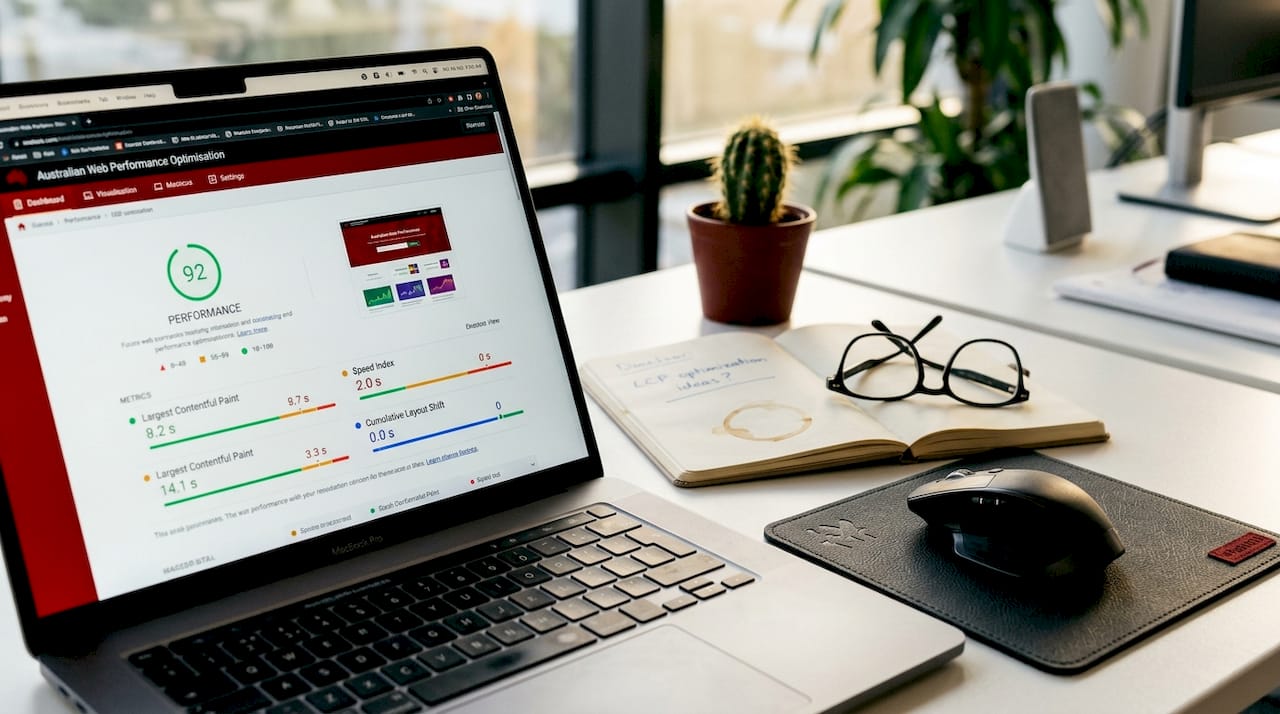
One framework worth knowing is Core Web Vitals. These are Google’s user-centric performance benchmarks. Largest Contentful Paint (LCP) measures how quickly the main content loads, with a good rating under 2.5 seconds. Interaction to Next Paint (INP) measures responsiveness, ideally under 0.2 seconds. Cumulative Layout Shift (CLS) measures visual stability and should stay below 0.1. Google uses these as ranking factors, measured at the 75th percentile of real user sessions.
Here is where most businesses go wrong. They make a change, assume it worked, and move on. Effective web performance optimisation relies on a feedback loop, not guesswork.
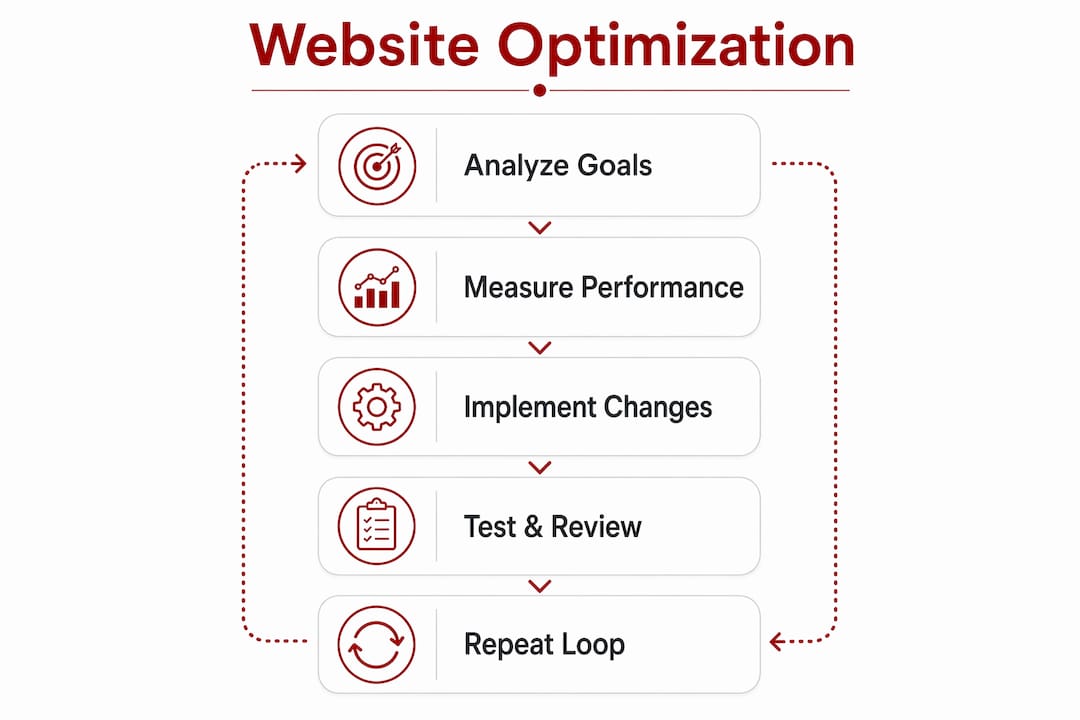
Continuous monitoring is what separates sites that improve over time from those that quietly deteriorate. A plugin update, a new image, or a third-party script can all introduce regressions you will not notice unless you are watching. The measure-diagnose-iterate cycle keeps your site on track.
Here is how to structure that cycle:
Pro Tip: Google Search Console’s Core Web Vitals report shows real user data for free. Check it monthly, not just when you notice a problem.
Web performance includes both objective measures like load time and frames per second, and the subjective sense of speed that users experience. A page that loads in two seconds but feels sluggish because content shifts around is still a poor experience. Both matter.
Understanding the theory is one thing. Knowing what to actually do with your website is another. The following covers the most effective steps for business owners and marketers to prioritise.
Image optimisation is the fastest win for most small business websites. Large, uncompressed images are one of the leading causes of slow load times. Convert images to modern formats like WebP, compress them before uploading, and use lazy loading so images below the fold do not delay the initial page load. Speed-related tactics also include reducing server response time, removing render-blocking scripts, and enabling browser caching.
Infrastructure and hosting set the baseline for everything else. A slow server adds latency before a single byte of your page loads. Front-end improvements like optimising CSS and JavaScript then fine-tune delivery on top of that solid foundation.
More than half of web traffic now comes from mobile devices. Your site needs to display and function properly on small screens without requiring users to pinch, zoom, or scroll horizontally. Check every page on an actual phone, not just a browser simulation. Pay attention to button size, font readability, and form usability.
On-page SEO covers elements like page titles, meta descriptions, heading structure, and keyword alignment between what people search for and what your pages say. Each service or product page should target a specific search term and answer the question behind that search clearly. A well-structured page with a clear heading hierarchy also helps Google understand your content, which supports local search visibility for Canberra businesses competing in a defined geographic market.
Getting traffic to your site is only half the work. CRO is the practice of improving how many of those visitors take a desired action, whether that is filling in an enquiry form, calling your number, or making a booking. Here is a comparison of two common approaches:
| Approach | What it involves | Best used for |
|---|---|---|
| Call-to-action (CTA) testing | Testing button text, colour, placement, and surrounding copy | Service pages, contact pages, booking flows |
| Landing page refinement | Adjusting headline, social proof, and form length for a specific offer | Paid campaigns, specific service promotions |
A converting website also relies on clear messaging above the fold, visible contact options, and trust signals like reviews and credentials. These are not design details. They directly affect whether a visitor stays or leaves.
Pro Tip: If you want to track website enquiries accurately, set up goal tracking in Google Analytics or Tag Manager before you start optimising. You need a reliable before-and-after comparison.
The benefits of website optimisation are not abstract. They connect directly to how your business performs online and off.
Website optimisation improves traffic, user navigation, conversions, retention, and ROI by making the site easier to find and easier to use. A faster, well-structured site ranks higher in search results, which means more visitors without additional advertising spend. Better UX keeps those visitors engaged longer and reduces the friction between arriving and taking action.
A one-second delay in page load time can reduce conversions by a significant margin. For a local service business with ten enquiries a month, even a modest improvement in conversion rate translates directly to more revenue.
Improved credibility is a less obvious benefit but a real one. A site that loads quickly, looks professional on every device, and gives visitors the information they need builds trust. For trades, allied health providers, consultants, and other service businesses in Canberra, trust is often the deciding factor in whether a visitor becomes a client.
The role of your website in client acquisition goes beyond simply having an online presence. An optimised site actively works to attract, qualify, and convert visitors. That is a meaningful competitive advantage in a local market where many businesses are still running slow, outdated, or poorly structured sites.
I have worked with a lot of small businesses on their websites, and the most common misconception I encounter is that optimisation means a redesign. It does not. In my experience, the biggest gains often come from changes that are barely visible: compressing images, fixing a slow-loading font, rewriting a confusing page headline, or moving a phone number above the fold.
What I have learned is that the mindset matters more than any individual tactic. Business owners who treat their site as something to monitor and improve regularly, even just quarterly, consistently outperform those who set and forget. The technical improvements compound. So do the content and SEO improvements.
I also think the distinction between lab data and real user data is genuinely underappreciated. I have seen sites that score well in a speed test but perform poorly for actual visitors on mobile networks in regional areas. That gap is where real optimisation work lives.
The other thing I would say is this: do not try to fix everything at once. Start with the pages that matter most, identify the single biggest friction point, fix it, measure the result, and move to the next item. Small, steady habits create a strong foundation. That approach is less exciting than a full rebuild, but it produces more reliable, lasting results.
— James
Understanding what website optimisation involves is the first step. Acting on it is where the results come from. At Asporeadigital, we work with Canberra small businesses to build and improve WordPress websites that load quickly, rank well in local search, and convert visitors into real enquiries.
Whether you are starting from scratch or want to improve what you already have, we can help you identify where your site is falling short and what to do about it. Our WordPress digital marketing guide is a good next step if you want to understand how your website fits into a broader growth strategy. If you are ready to talk about your site specifically, get in touch with the Asporeadigital team directly. Clear advice, fixed pricing, and no technical runaround.
Website optimisation is the ongoing process of improving your site’s speed, usability, search visibility, and conversion performance so it works more effectively for your business.
Google uses Core Web Vitals, measured from real user data, as ranking factors. Good performance benchmarks include an LCP under 2.5 seconds and a CLS below 0.1, both of which contribute to higher search rankings.
Optimisation is not a one-time task. Continuous monitoring and regular small improvements produce better long-term outcomes than infrequent major overhauls.
SEO focuses specifically on improving search visibility through content, keywords, and technical signals. Website optimisation is broader and includes SEO alongside speed, UX, mobile usability, and conversion improvements.
Start with the pages that drive the most business value, typically your home page, key service pages, and contact page. Identify the biggest friction point on each and address it with one change at a time, measuring the result before moving on.

Standard websites lack the tools astrology visitors expect. See how custom astrology websites attract, engage and retain users.

This auto-refresh plugin adds a neat on or off switch to any page so the page refreshes itself on a safe schedule with a shortcode.
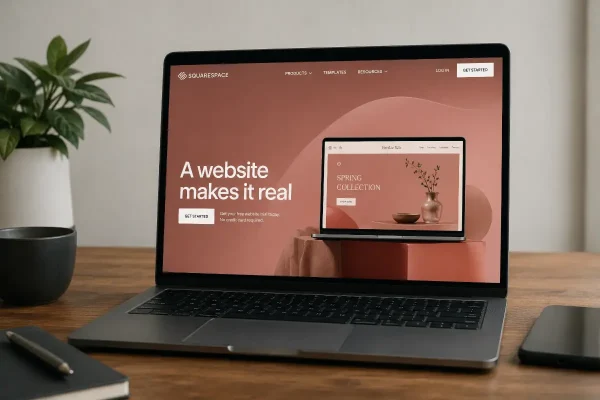
DIY Squarespace can look cheap, but hidden costs, owner time and growth limits can make WordPress the smarter long-term choice.