Blog

Turning One-Time Buyers into Loyal Subscribers
Subscription websites build steady income and loyalty. Learn the difference in WooCommerce and see if it’s right for your business.

TL;DR:
- Website design greatly influences first impressions and trust in small businesses.
- Consistent, personalized design elements help build memorable brand recognition.
- Avoid generic templates by customizing visuals and messaging to stand out locally.
Most small business owners in Canberra spend months refining their logo and crafting a tagline, then launch a website that quietly contradicts everything those assets stand for. The uncomfortable truth is that your brand is shaped far more by how your website feels to use than by any single design asset. Visitors form an impression within milliseconds of landing on your site, and that impression sticks. This guide walks you through why website design is central to brand identity, which specific elements matter most, the traps that quietly erode your credibility, and how to turn smart design decisions into real customer engagement and sales.
| Point | Details |
|---|---|
| Design shapes perception | Your website’s look and feel is the first thing customers associate with your brand. |
| Avoid template traps | Generic templates can make your business forgettable—custom elements create distinction. |
| Consistency builds trust | Unified colours, messaging, and layouts help build credibility with Canberra customers. |
| Experience drives loyalty | Prioritising smooth navigation and engagement over mere efficiency earns repeat business. |
| Mobile matters most | A mobile-friendly website is critical to reaching and impressing a wider Canberra audience. |
With the stakes of branding established, it is worth examining why website design sits at the centre of modern brand identity. Your website is almost always the first place a potential customer encounters your business in a controlled, considered way. Unlike a social media post or a word-of-mouth referral, your website is entirely within your control, which makes every design decision a deliberate brand statement.
Layout, colour, and navigation all communicate something before a single word is read. A cluttered page signals disorganisation. A slow-loading site signals neglect. Clean spacing and intuitive menus signal that you respect your visitor’s time. These are not subtle messages. They land immediately and shape whether someone trusts you enough to keep reading.
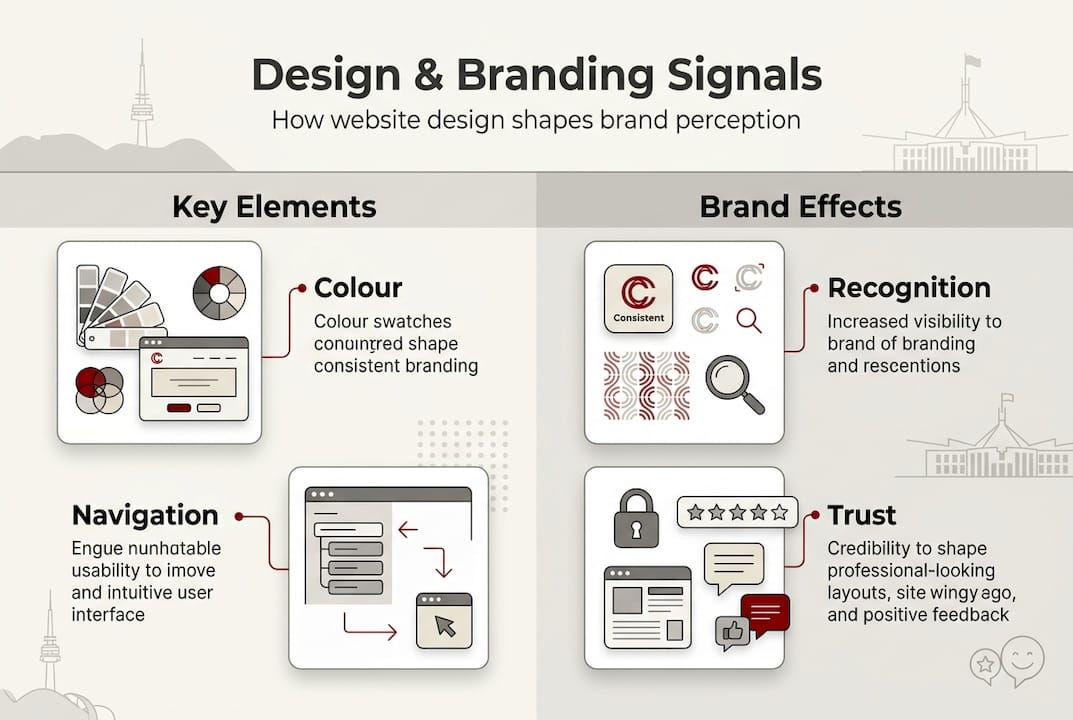
Research into web design behaviour confirms that prototypical designs are preferred for web-oriented users, while homogenous designs work better for store-oriented contexts. In plain terms, this means that your website needs to feel familiar enough to navigate easily, but distinct enough to be remembered. It is a balance worth taking seriously.
| Design element | Brand signal | Risk if neglected |
|---|---|---|
| Colour palette | Consistency and personality | Looks unpolished or generic |
| Typography | Tone and professionalism | Feels dated or hard to read |
| Navigation structure | Clarity and confidence | Visitors leave without enquiring |
| Mobile responsiveness | Reliability and care | Loses trust on smartphones |
| Page load speed | Competence and attention to detail | High bounce rates |
The balance between familiarity and uniqueness is one of the most nuanced challenges in web design. Go too generic and you blend into the background. Go too unusual and visitors feel disoriented. The goal is a site that feels immediately usable but leaves a clear impression of who you are.
For Canberra businesses, this matters because the local market is competitive and increasingly digital. Customers are comparing you to other local providers in seconds. A well-considered design, explored further in these design tips for Canberra SMBs, can be the difference between a visitor enquiring or clicking away.
“Experience attributes now drive loyalty more than efficiency alone. Customers remember how your website made them feel, not just whether it worked.”
Visual identity and user experience are not separate concerns. They reinforce each other constantly. A site that looks great but is confusing to navigate undermines your brand just as much as one that works well but looks amateur. The two must move together, and that is precisely what modern website design growth focuses on for local businesses.
Understanding the importance of design, it is vital to break down the specific elements that set your brand apart. These are not abstract concepts. They are practical decisions you make, or leave unmade, every time your site is built or updated.
Here is a comparison of design approaches and their branding impact:
| Approach | Branding outcome | Best suited for |
|---|---|---|
| Prototypical design | Familiar, easy to use | Broad audiences, service businesses |
| Unique custom design | Memorable, differentiated | Niche providers, creative industries |
| Template with no customisation | Forgettable, generic | Not recommended for growth |
| Template with custom elements | Balanced, cost-effective | Small businesses starting out |
The key design elements to prioritise are:
Research confirms that you must balance prototypicality for familiarity against the need for differentiation. Too much similarity to competitors and you become invisible. Too much departure from convention and you create confusion.
Custom graphics, original photography, and tailored illustrations can all aid recall when used with purpose. These are explored in detail through WordPress customisation examples for Canberra businesses, and the WordPress advantages that make this kind of flexibility achievable without excessive cost.
Pro Tip: Before launching any design update, view your site on three different devices: a desktop, a tablet, and a phone. If it looks and works well on all three, you are on solid ground.
Looking at strong brand examples from businesses that have built lasting recognition, the common thread is consistency. Not perfection. Consistency. Your brand builds trust through repetition, and your website is where that repetition happens most reliably.
If you need more guidance on the technical side of achieving this, custom website development for Canberra businesses covers how to build these elements into a site from the ground up.
After learning what successful design looks like, it is just as important to understand the traps that quietly undermine your branding. The most common one is the template trap.
Using a generic template is understandable when you are starting out. Templates are affordable, fast to set up, and look acceptable at a glance. The problem is that thousands of other businesses are using the same template. When your site looks identical to a competitor’s, your brand becomes invisible. Visitors cannot remember you, and they cannot distinguish you from anyone else in your market.
Research shows that generic templates risk indistinguishable branding, directly harming memorability and customer loyalty. This is not a minor concern. It is a structural problem that limits your ability to grow.
The case illustration of indistinguishability from Bimbobike demonstrates how even a well-intentioned brand can fade into the background when its visual identity lacks distinctiveness. The lesson applies directly to Canberra small businesses operating in crowded local markets.
Here are the most common template-related pitfalls to watch for:
“A website that looks like everyone else’s tells your customers that your business is like everyone else’s too.”
The good news is that you do not need to spend a fortune to break out of this trap. Small, deliberate changes make a meaningful difference. Adding original photography, using a custom colour palette, and writing copy in your own voice are all low-cost ways to create distinction.
Pro Tip: Search for your top three local competitors and screenshot their websites. If yours looks similar, it is time to make some changes. Differentiation does not require a full redesign. It starts with awareness.
For practical examples of how to customise a WordPress site without starting from scratch, see WordPress customisation examples. And if you are unsure whether your current site is matching your business goals, that is a good place to start the conversation.
Avoiding pitfalls means your brand stands out. Now it is time to turn smart design into real action and results. Good design is not just about looking professional. It is about guiding visitors toward the actions that matter to your business.
Here is a step-by-step approach to using design for engagement:
Research confirms that experience attributes outperform efficiency in driving loyalty and customer retention. Customers come back to sites that feel good to use, not just sites that work.
Pro Tip: Add a prominent phone number or enquiry button to your mobile header. For many Canberra service businesses, a single tap-to-call button has been the highest-converting element on the entire site.
Useful resources for applying these ideas include web design tips for local success, guidance on the importance of professional web hosting, and how to create a clear path to purchase for your visitors.
Knowing when to consider rebranding is also worth understanding. Sometimes the issue is not a single element but a broader misalignment between your current site and where your business is heading.
Moving from practical advice, here is a hard-earned viewpoint on what actually creates lasting branding impact for Canberra businesses online.
Conventional wisdom pushes small businesses toward safe, neutral design. The thinking is that a clean, inoffensive site will appeal to everyone. In practice, it appeals to no one in particular. The businesses we see building genuine recognition in Canberra are the ones willing to make a clear visual statement and then hold to it consistently across every page, every interaction, and every update.
Real branding wins do not come from a single design overhaul. They come from the steady, repeated application of the same visual language. The same fonts. The same colours. The same tone in every headline. Over time, that consistency becomes recognition, and recognition becomes trust.
The other pattern worth noting is that businesses that iterate based on customer response outperform those that treat their website as a finished product. Your site should evolve as your understanding of your customers deepens. That is not a weakness. It is a strategy.
If you want to see what this looks like in practice, modern web design for business growth and top web design tips are good starting points.
If your website is not reflecting the quality of your business, or if you are not sure whether it is working as hard as it should, you are not alone. Many Canberra small businesses are running sites that look dated, perform poorly on mobile, or simply do not convert visitors into enquiries.
Asporea Digital builds fixed-price WordPress websites designed specifically for Canberra businesses. Whether you need a fresh start or a targeted improvement, we can help you create a site that strengthens your brand and drives real results. Explore modern website design options and WordPress customisations for Canberra businesses, or get started with Asporea to discuss your goals and get a clear, fixed quote.
A well-designed website signals professionalism immediately, and brand perception starts forming from the very first visit. Customers decide whether to trust you within seconds of landing on your site.
Consistent use of colour, logo placement, clear navigation, and mobile performance are the foundation of memorable branding. Research confirms that logo, colour, and typography must work together to build recognition.
Templates can be a practical starting point, but without custom visuals and messaging you risk blending in. Generic templates risk indistinguishable branding that weakens memorability and loyalty over time.
Clear calls to action, fast load times, easy mobile navigation, and design that reflects your values all drive engagement. Experience attributes outperform efficiency when it comes to keeping customers coming back.

Subscription websites build steady income and loyalty. Learn the difference in WooCommerce and see if it’s right for your business.
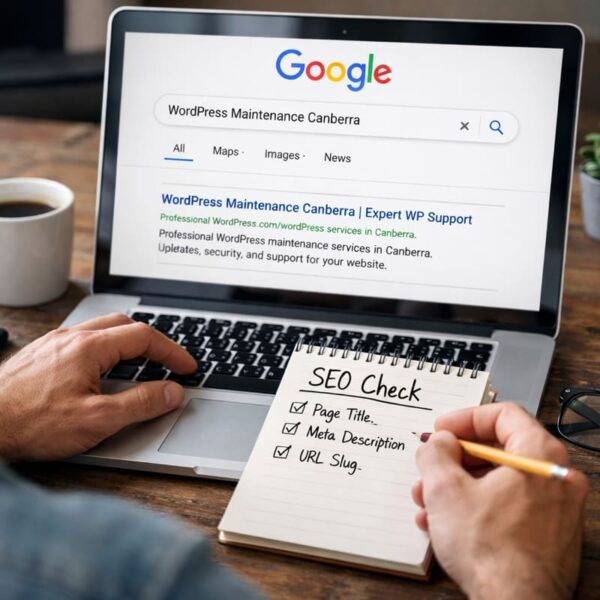
Stop searching your business name. Run a simple SEO check, fix your page title, description and slug, and help strangers find you.
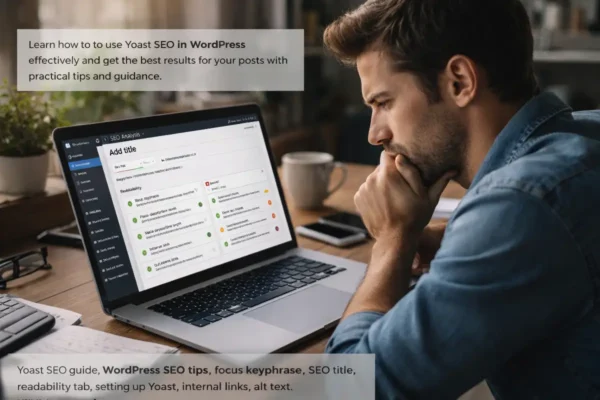
A practical Yoast SEO guide for WordPress users who want clearer posts, stronger search signals and better Google results.