
Blog

When Meta Cuts You Off, What Happens to Your Business?
What happens if Meta cuts off your Facebook or Instagram tomorrow? Why your website should be the centre of your business, not social media.

A revenue-focused website is defined as a digital asset built specifically to convert visitors into paying customers or qualified leads, not to display information or win design awards. This is the core distinction between a sales-driven site and a traditional “digital brochure.” Most small business websites fall into the brochure category: they look presentable, explain what the business does, and then leave the visitor with no clear next step. A revenue-generating website does the opposite. It is structured around user behaviour, conversion rate principles, and measurable business outcomes. Most successful sites begin showing measurable income within 3–6 months, with meaningful growth arriving in the 12–18 month range. That timeline matters because it sets realistic expectations and underscores why the site needs to be built correctly from day one.
A revenue-focused web design is built to influence specific user actions with measurable business growth outcomes, unlike traditional sites that chase vanity metrics like page views and session duration. The difference is not cosmetic. It is structural. A brochure site presents information and hopes the visitor acts. A revenue-focused site removes friction, guides the visitor through a deliberate path, and makes the next step obvious at every point.
Traditional websites often treat the homepage as a company profile. Revenue-focused sites treat it as the opening of a sales conversation. Every heading, image, and button placement is chosen because it supports a conversion goal, not because it looks balanced on screen. This shift in thinking changes everything about how a site gets built.

For small business owners, this matters because your website is often the first and only impression a potential client gets. If that impression does not lead somewhere useful, you have paid for a brochure that sits in a drawer.
A growth stack combining speed, UX, SEO, and automation turns a passive website into a 24/7 sales engine. Each of these four pillars does a specific job, and removing any one of them weakens the whole structure.
The features that separate a revenue-generating website from a standard one include:
Pro Tip: Set up Google Analytics 4 with conversion tracking before your site launches, not after. Waiting until the site is live means losing weeks of baseline data you cannot recover.
Mobile responsiveness belongs on this list too. A site that breaks on a phone is not just inconvenient. It signals to the visitor that the business is not paying attention, and that impression carries over to how they perceive your service quality.
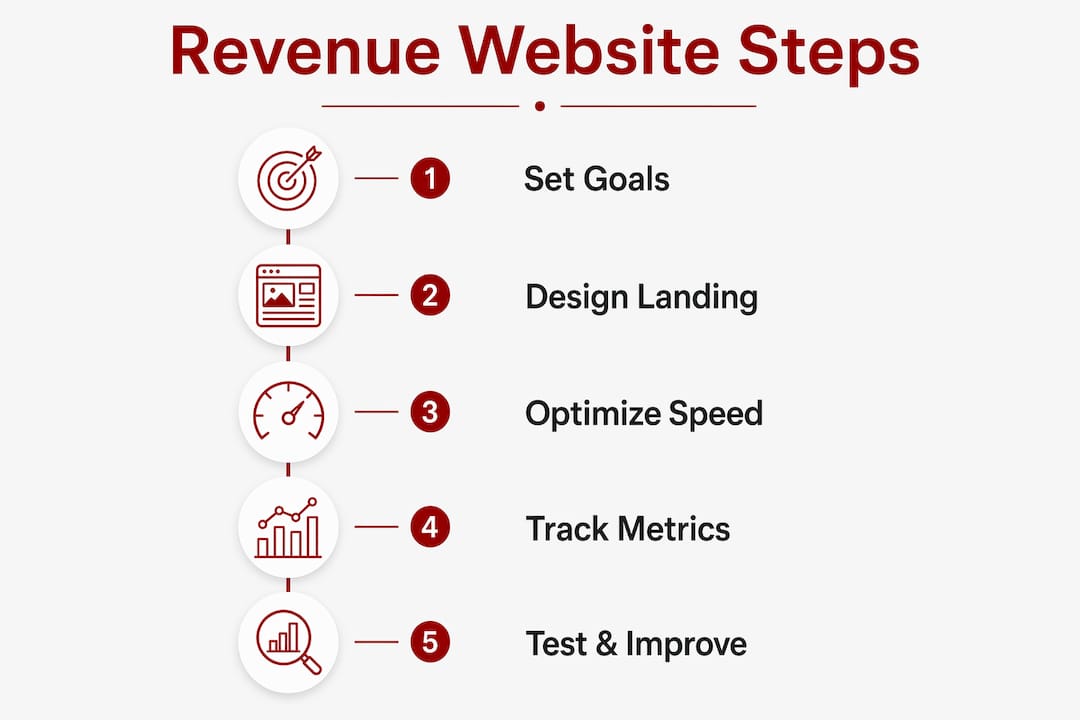
The mechanism is straightforward, but the execution requires discipline. A revenue-generating website converts traffic into income by moving visitors through a deliberate sequence: awareness, interest, decision, and action. Each stage of that sequence needs to be supported by the right content, the right page structure, and the right next step.
The first thing to get right is your metrics. Leadership teams often track page views and bounce rates while missing the connection between website interactions and closed deals. That is a costly blind spot. The metrics that matter are enquiry volume, lead-to-sale conversion rate, cost per lead, and revenue attributed to organic search.
The income generation process works like this:
A 1% improvement in conversion rate on a site with a $100 average order value adds $10,000 in revenue per 10,000 visitors. Small, steady improvements compound into significant income over time.
Lead quality matters as much as conversion volume. Increasing conversion rate by 50% without filtering for lead quality can flood your sales process with unqualified enquiries. The goal is qualified leads, not just more leads.
Building a site that generates income is not about spending more on design. It is about making deliberate decisions at each stage of the build. These steps apply whether you are starting from scratch or improving an existing site.
Set a revenue goal first. Before choosing colours or writing copy, decide what the site needs to achieve. Ten new enquiries per month. Fifty online sales per week. A specific dollar figure in bookings. A clear goal shapes every other decision.
Build streamlined landing pages. Each service or product needs its own page with a single conversion goal. A page that tries to explain everything and sell everything converts nothing. Keep the structure simple: problem, solution, proof, action.
Prioritise site speed and mobile performance. Performance hosting directly affects how fast your pages load and how reliably they stay online. A slow or unreliable site loses revenue quietly, without any obvious error message to alert you.
Write copy for the customer, not the business. Most small business websites talk about the business. Revenue-focused copy talks about the customer’s problem and how it gets solved. “We have 15 years of experience” is less persuasive than “You will have a quote in 24 hours.”
Integrate website automation tools from the start. Booking confirmations, enquiry responses, and follow-up sequences should run without manual effort. Automation reduces admin and keeps leads engaged during the gap between enquiry and contact.
Run A/B tests on your highest-traffic pages. Test one element at a time: headline, button text, form length, or page layout. Changes based on data outperform changes based on opinion every time.
Pro Tip: If your contact form has more than five fields, remove at least two. Minimal form fields reduce visitor friction and increase the number of people who complete the form. You can gather more detail once the conversation has started.
| Approach | Revenue impact |
|---|---|
| Generic homepage with no clear CTA | Low conversion, high bounce rate |
| Dedicated landing pages per service | Higher conversion, lower cost per lead |
| Manual follow-up only | Leads go cold between enquiry and contact |
| Automated email follow-up sequence | Leads stay warm, higher close rate |
| Traffic focus without conversion work | More visitors, same revenue |
| Conversion focus with targeted traffic | Fewer visitors, more paying clients |
The most common mistake is treating the website as a finished product. A site that is not being tested, updated, and improved is slowly becoming less effective as visitor behaviour and search algorithms change around it.
Chasing traffic without conversion work is the second most expensive mistake. More visitors to a page that does not convert just means more people leaving without acting. Fix the conversion problem before spending on advertising or SEO.
Overloading forms is a consistent conversion killer. Asking for a phone number, company name, budget range, project timeline, and preferred contact method before you have even started a conversation sends visitors elsewhere. Forms should request only essential data to reduce friction and start the dialogue.
Ignoring lead quality creates a different problem. A site optimised purely for volume can generate enquiries from people who are not ready to buy, cannot afford the service, or are outside the target area. For a Canberra trades business or allied health provider, an enquiry from the wrong suburb or the wrong budget range wastes time that could go to a qualified prospect.
Pro Tip: Add one qualifying question to your contact form, such as “What is your approximate budget?” or “When are you looking to start?” This single field filters out a large proportion of unqualified enquiries without significantly reducing form completions.
Removing distractions from landing pages is often overlooked. A full navigation menu on a campaign page gives visitors twelve ways to leave and one way to convert. Stripping navigation from landing pages keeps attention where it belongs. This is one of the simplest changes a small business can make, and it costs nothing to implement.
Asporeadigital works with small businesses across Canberra and the Capital Territory to build WordPress websites that are commercially focused from the ground up. Every project is scoped around business outcomes: enquiries, bookings, and sales, not just appearance.
The team at Asporeadigital handles design, WordPress development, WooCommerce store setup, SEO, automation, and ongoing support under one roof. Fixed pricing means no surprises, and the local Canberra focus means you get advice that reflects how your market actually works. If your current site is not generating enquiries at the rate your business needs, a WordPress digital marketing review is a practical starting point.
A revenue-focused website generates income by combining fast load times, targeted SEO, frictionless conversion paths, and automation into a single, measurable system.
| Point | Details |
|---|---|
| Definition is structural, not cosmetic | A revenue-focused site guides visitors to act, not just informs them. |
| Speed directly affects revenue | Pages loading in under 2 seconds retain more visitors and convert at higher rates. |
| Lead quality beats lead volume | Filtering for qualified enquiries saves time and increases your close rate. |
| Landing pages outperform generic pages | Removing navigation keeps visitor attention on the conversion action. |
| Testing is ongoing, not optional | Small, data-driven improvements compound into significant revenue gains over time. |
A revenue-focused website is a site built to convert visitors into leads or paying customers through deliberate design, fast performance, and clear conversion paths. It differs from a brochure site by prioritising measurable business outcomes over aesthetics.
Most sites begin showing measurable income within 3–6 months, with significant and sustainable revenue growth typically arriving in the 12–18 month range.
Track enquiry volume, lead-to-sale conversion rate, cost per lead, and revenue attributed to organic search. Page views and bounce rates alone do not reflect whether your site is generating income.
Request only the fields needed to start a conversation. Name, email, and one qualifying question is usually sufficient. Minimal form fields reduce friction and increase the number of visitors who complete the form.
A dedicated landing page per service or campaign consistently outperforms a single generic page. Focused pages with one clear call to action convert at higher rates because they match the visitor’s specific intent.

What happens if Meta cuts off your Facebook or Instagram tomorrow? Why your website should be the centre of your business, not social media.

Thinking of launching a membership site? Learn the reality checks, content demands and signs you are truly ready.

Practical WordPress security basics for Australian small businesses, covering logins, updates, backups, plugins, hosting and monitoring.