
Blog

Maintaining Website resilience when EOFY distracts
EOFY pressure? Build website resilience with WordPress updates, 2FA, offsite backups and a restore test so your site keeps selling.

Face-to-face web service is defined as the deliberate use of in-person interaction within a digitally supported customer journey, reserved for moments where human judgement, transparency, and trust cannot be replicated by a screen alone. For small businesses and service providers, this is not a nostalgic preference. It is a practical response to the limits of digital channels. As more routine transactions shift online, the interactions that remain in person are becoming more complex, more emotionally loaded, and more consequential. Getting them right matters more than ever.
The role of face-to-face web service is to resolve the trust gaps that digital channels consistently leave open. A website can inform, a booking form can capture intent, and a chatbot can answer FAQs. None of these can replicate what happens when a person reads the room, adjusts their tone, and confirms that a client genuinely understands what they are agreeing to.
Research from a 2026 J-STAGE travel agency study confirms this directly. Non-verbal cues and perceived similarity in face-to-face encounters mediate trust formation across cognitive, affective, and behavioural dimensions. That means the way a staff member mirrors a client’s communication style, maintains eye contact, and responds to hesitation all contribute to whether that client feels confident enough to proceed.
The benefits for small businesses are concrete:
A 2026 Scientific Reports experiment with 517 adults found that transparency paired with interpersonal interaction produced the highest trust scores. Web-based systems that were non-transparent and low-interactive produced the lowest. The gap between those two conditions is where small businesses either win or lose clients.
Pro Tip: Train your staff to recognise and mirror the communication style of each client. Cognitive, affective, and non-verbal similarity are all measurable and teachable. A staff member who adjusts their pace, vocabulary, and body language to match a client builds trust faster than any digital touchpoint.
Face-to-face service is not the whole journey. It is the resolution layer at the end of a well-designed digital process. The two channels serve different purposes, and confusing them wastes both time and money.
Here is how the orchestration works in practice:
This structure reduces the cost of your in-person time by ensuring it is never spent on questions a webpage could have answered. It also means the client arrives at the meeting already informed, which makes the conversation more productive.
Pro Tip: Before any face-to-face consultation, send a short digital intake form that captures the client’s main concern, their preferred outcome, and any constraints they are working within. You arrive prepared. They feel heard before the meeting even starts.

Digital channels fail in predictable ways. The failure is rarely dramatic. It accumulates quietly through friction, opacity, and the absence of a human voice when a client needs one.
The Digital Trust Index 2026 puts numbers to this pattern. Login and sign-up friction caused 68% of consumers to abandon or switch providers. Separately, 57% reported experiencing website access problems. These are not edge cases. They represent the majority of digital interactions going wrong at the first hurdle.
The risks of a digital-only approach include:
The practical implication for small businesses is clear. Your digital presence needs to be honest, fast, and easy to navigate. But it also needs a clear path to a human. That path is the importance of in-person web services made visible: a phone number, a booking link, a consultation option. Without it, your website is a dead end for anyone who needs more than information.
Clients do not choose between digital and face-to-face randomly. They choose based on how much is at stake and how much they already trust you.
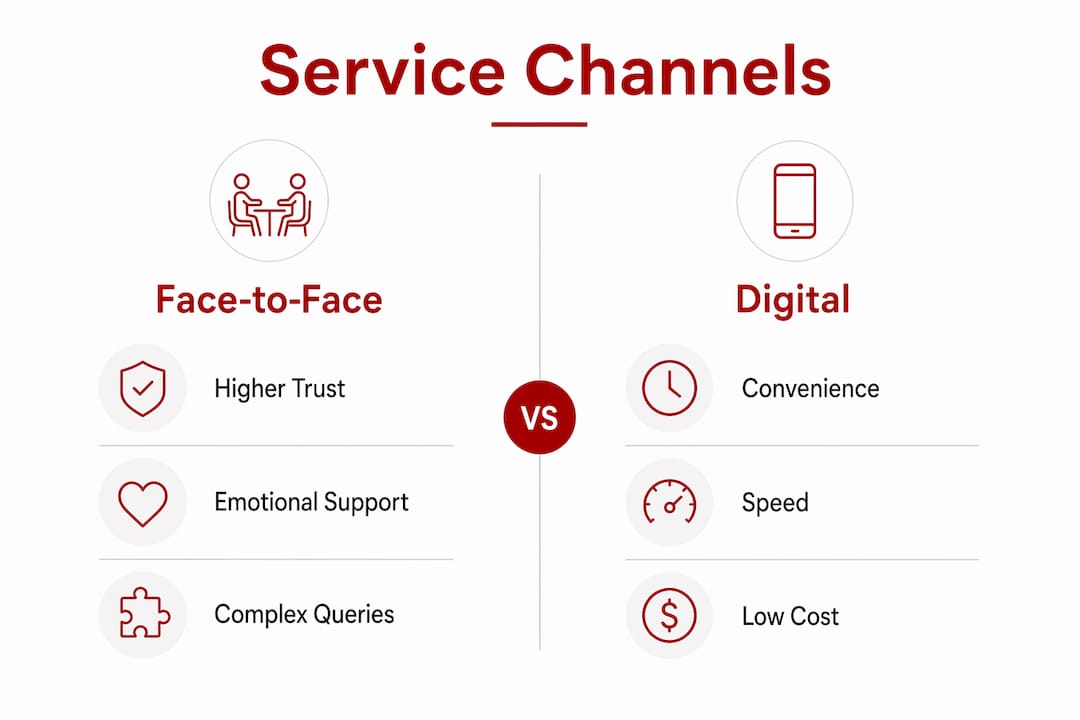
A 2026 PubMed survey of 934 German adults found that face-to-face is preferred for emotionally sensitive consultations, while digital and AI formats are acceptable for routine, low-emotion tasks when trust in the diagnosis is already high. This pattern holds across industries. A client booking a repeat service they have used before is comfortable doing it online. A client making a first-time decision about their health, finances, or legal situation wants a person.
For small businesses, this means channel design should follow the client’s emotional context, not just operational convenience. A Canberra allied health provider, for example, might handle appointment bookings and intake forms entirely online. The initial consultation, however, carries enough emotional weight that offering a face-to-face option is not a luxury. It is a conversion tool. Clients who feel they can meet you in person are more likely to book at all.
The same logic applies to financial advisers, legal consultants, and trades businesses quoting on significant projects. The role of personal interaction online is to signal that a human is available when the stakes rise. Your website communicates this through clear contact options, visible consultation booking, and social proof that shows real client relationships rather than generic testimonials.
Service design that ignores emotional context pushes clients toward competitors who offer the reassurance they need. The fix is not complicated. It is a matter of identifying which decisions your clients find stressful and making sure a human is reachable at exactly that point.
Face-to-face web service builds the trust that digital channels cannot manufacture, and small businesses that design their customer journey around this fact convert more clients and retain them longer.
| Point | Details |
|---|---|
| Face-to-face resolves trust gaps | In-person interaction produces higher trust than transparent digital systems alone, per Scientific Reports 2026. |
| Digital handles routine, face-to-face handles complexity | Reserve in-person time for high-stakes, emotionally sensitive consultations after digital pre-qualification. |
| Digital friction causes real losses | 68% of consumers abandon slow or complicated digital processes, making a clear human contact path non-negotiable. |
| Perceived similarity builds relational trust | Staff trained in non-verbal and cognitive mirroring form stronger client relationships faster. |
| Channel choice should follow emotional context | Clients prefer face-to-face for sensitive decisions and accept digital for routine tasks when trust is already established. |
Building a website that supports both digital efficiency and face-to-face engagement requires more than a good design. It requires a clear understanding of how your clients move through a decision.
Asporeadigital works with small businesses in Canberra and the Capital Territory to build WordPress websites that do exactly this. That means clear service pages, fast load times, honest contact options, and booking systems that qualify clients before they reach you. The goal is a site that handles the routine work digitally and makes it easy for clients to take the next step toward a real conversation. If you are ready to build a website that supports your full client journey, the WordPress digital marketing guide is a practical starting point. You can also explore effective homepage design to see how the right structure supports both digital engagement and in-person conversion.
Face-to-face web service is the practice of combining in-person interaction with a digital customer journey, using human contact at the moments where trust, complexity, or emotional sensitivity require it. It is not a replacement for digital channels but a deliberate complement to them.
Face-to-face interaction produces higher trust than digital channels alone, particularly for complex or emotionally sensitive decisions. A 2026 Scientific Reports study found that transparent, interpersonal interaction generates the highest trust scores of any communication format tested.
Offer face-to-face service when a client is making a high-stakes or first-time decision, when digital friction has caused hesitation, or when the consultation involves trade-offs that require judgement. QTRAC’s 2026 guidance confirms that in-person interactions now cluster around exactly these high-complexity moments.
The Digital Trust Index 2026 found that 68% of consumers abandoned or switched providers due to slow or complicated digital processes. Poor digital experiences do not just lose transactions. They damage the trust that face-to-face service would otherwise build.
A well-designed website supports face-to-face engagement by qualifying clients digitally before the meeting, providing clear contact and booking options, and using testimonials and social proof to signal that real relationships are available.

EOFY pressure? Build website resilience with WordPress updates, 2FA, offsite backups and a restore test so your site keeps selling.

A newsletter keeps you in touch with interested visitors. Stay useful, stay remembered, and bring people back to your website when they’re ready.
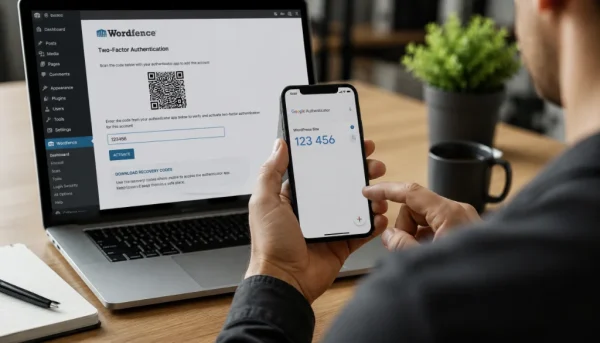
Protect your WordPress login with Wordfence 2FA, Google Authenticator and backup codes to reduce the risk of unwanted access.