
Blog

WordPress Security Basics Every Small Business Website Should Get Right
Practical WordPress security basics for Australian small businesses, covering logins, updates, backups, plugins, hosting and monitoring.

Content marketing is the practice of creating and sharing useful, relevant content to attract and keep customers, and it is one of the most cost-effective growth strategies available to small businesses. 87% of marketers report that content marketing has increased their brand awareness, and 76% say it generates higher-quality leads across the buyer journey. Those numbers reflect a simple truth: people buy from businesses they trust, and trust is built through consistent, helpful information, not through ads. Understanding why content marketing matters gives you a clearer picture of where to put your time and budget for the best long-term return.
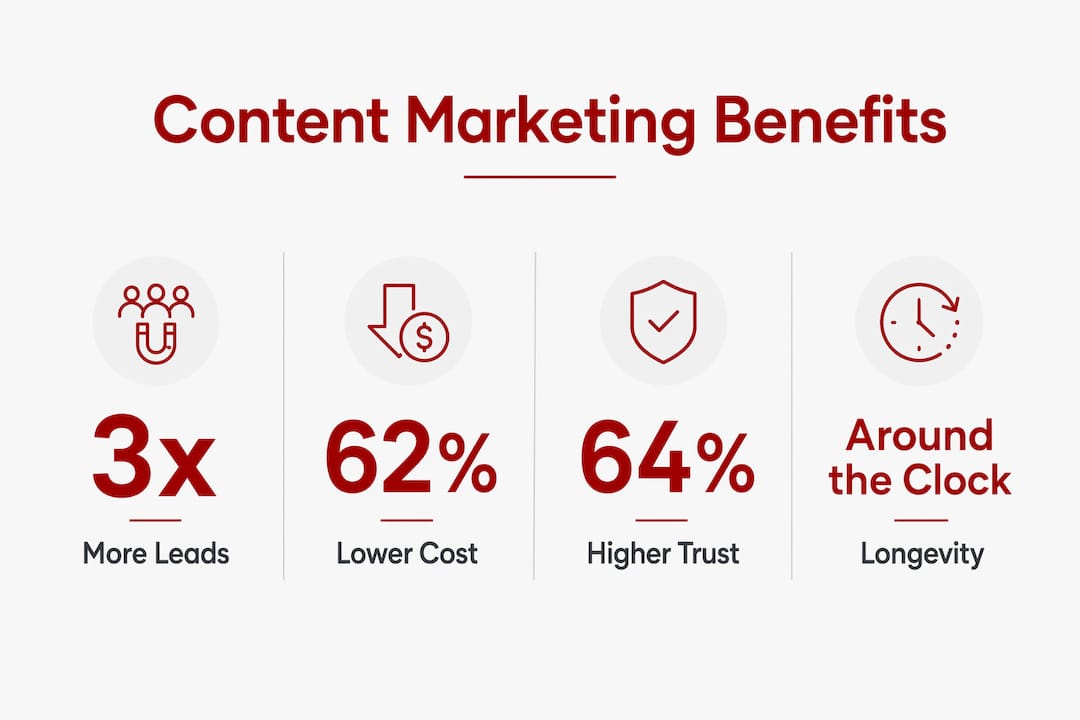
Traditional advertising has a credibility problem. 96% of people distrust ads, but 64% trust brands that produce educational content. That trust rises to 73% after just one week of consuming that content. The gap between those two figures is where content marketing does its best work.
When you publish a helpful blog post, a practical guide, or a detailed case study, you are demonstrating knowledge rather than just claiming it. Readers notice the difference. A Canberra trades business that publishes a clear guide on what to check before calling a plumber signals competence in a way that a display ad simply cannot.

Consistent content also builds what Google calls E-E-A-T signals: Experience, Expertise, Authoritativeness, and Trustworthiness. E-E-A-T is critical for ranking well in Google’s current algorithms and in AI-powered search platforms. This means that the content you publish today does double duty: it builds trust with readers and it signals credibility to search engines.
Content types that build credibility most reliably include:
Pro Tip: Publish content that answers the exact questions your customers ask you in person. Those conversations are a direct window into what your audience needs, and they make the best starting points for content that earns real trust.
Content marketing generates three times more leads per dollar spent than traditional outbound advertising, at 62% lower cost. For a small business working with a tight budget, that ratio matters enormously.
The reason content outperforms paid ads on lead quality comes down to self-selection. When someone reads a detailed article about your service, works through your guide, and then contacts you, they arrive already informed. Good content shortens sales cycles because prospects come pre-qualified through education. You spend less time explaining the basics and more time closing.
Content also filters for high-quality leads by answering niche questions that only serious buyers would search for. A generic Facebook ad reaches everyone. A detailed article on “what to look for in a Canberra bookkeeper” reaches exactly the person who is ready to hire one.
The buyer journey has distinct stages, and content supports each one differently:
The compound effect of publishing across all four stages means your content works around the clock. A blog post published today can still be generating enquiries in two years. Paid ads stop the moment you stop paying.
| Marketing method | Cost per lead | Lead quality | Longevity |
|---|---|---|---|
| Content marketing | Lower over time | Higher (self-qualified) | Compounds over months and years |
| Paid advertising | Higher, ongoing | Variable | Stops when budget stops |
| Traditional outbound | Highest | Lower (broad targeting) | No residual value |
Pro Tip: Track which content pieces generate the most enquiries, not just the most traffic. A page with 200 visits and 10 enquiries outperforms a page with 2,000 visits and zero contact. Optimise for conversion, not just clicks.
For a practical framework on putting this into practice, the content creation process for small businesses guide from Asporeadigital walks through each stage in plain terms.
Content marketing costs 62% less than traditional outbound advertising. For a small business in Canberra spending $1,000 a month on Google Ads, that comparison is worth pausing on.
The more useful way to think about content is as an asset, not an expense. Each piece you publish adds long-term value and continues drawing traffic and leads long after the work is done. A well-written service page or a thorough guide behaves like a deposit in an account that keeps paying interest. Paid ads behave like rent: useful while you pay, gone when you stop.
Small businesses also benefit from the resilience that a repeatable content system provides. When Google updates its algorithm or ad costs spike, businesses with strong content libraries are far less exposed than those relying entirely on paid channels. Content builds a foundation that does not disappear overnight.
Practical ways to keep content costs manageable:
Pro Tip: Consistency beats volume. One well-researched, genuinely useful article published every two weeks builds more authority than a burst of ten thin posts followed by three months of silence.
For a broader look at how content fits into a local business marketing plan, Asporeadigital has covered the Canberra context specifically.
AI is changing how content gets made, but it has not changed what makes content worth reading. 20% of marketers now use AI to automate content production, and 68% of firms using AI report significant improvements in content marketing ROI. Those figures reflect genuine efficiency gains, not hype.
AI tools speed up research, drafting, and formatting. They make it practical for a small business to maintain a consistent publishing schedule without hiring a full-time writer. For a Canberra allied health provider or a local consultant, that is a real advantage.
The risk sits on the other side of the ledger. AI floods the internet with low-quality content, and search engines are getting better at identifying it. Google’s E-E-A-T framework specifically rewards content that demonstrates genuine experience and expertise, qualities that AI alone cannot manufacture.
“AI makes content production faster and cheaper, but it also floods the internet with low-quality content. Balancing AI-generated output with human expertise remains the critical factor for building trust and maintaining search visibility in 2026.”
The businesses that use AI well treat it as a production tool, not a strategy tool. They use it to draft and format, then apply human judgement to add specific examples, local context, and genuine opinion. That combination produces content that is both efficient to create and credible to read. A useful starting point for understanding how this applies locally is this guide to content marketing for WordPress, which covers the practical side of publishing consistently on a WordPress site.
For a broader perspective on what content marketing actually is and how small businesses can approach it sustainably, this guide for small businesses from CloudSprout covers the fundamentals clearly.
Content marketing builds compounding brand authority and lead flow over time, making it the most cost-effective growth channel available to small businesses with limited budgets.
| Point | Details |
|---|---|
| Trust drives conversions | 64% of people trust brands that publish educational content, compared to 96% who distrust ads. |
| Content generates better leads | Content marketing produces three times more leads per dollar than outbound advertising at 62% lower cost. |
| Results take time | Meaningful outcomes typically emerge between months 4 and 12 of consistent publishing. |
| AI assists but does not replace expertise | AI speeds up production, but human judgement and local knowledge are what build genuine credibility. |
| Content is a long-term asset | Unlike paid ads, published content continues attracting traffic and enquiries for years after it goes live. |
Asporeadigital works with small businesses across Canberra and the Capital Territory to build WordPress websites that support real content marketing outcomes. A well-built site is the foundation that makes your content work harder: fast load times, clear service pages, and a structure that search engines can read properly.
If you are ready to put a content strategy behind a website that is built for it, the WordPress digital marketing growth guide is a practical place to start. Asporeadigital also offers content direction and SEO support as part of its ongoing website care plans, so you have a local team to work with rather than figuring it out alone. Reach out through asporeadigital.com to talk through what your business needs.
Content marketing is the practice of creating useful, relevant content to attract and retain customers. It includes blog posts, guides, videos, and service pages that educate prospects and build trust over time.
Results typically take 3–6 months to appear, with stronger growth occurring between months 4 and 12 of consistent publishing. Patience and consistency are the two non-negotiable requirements.
Content marketing builds a repeatable lead generation system that reduces reliance on paid ads and is resilient to algorithm changes. For a local business with a limited budget, that long-term stability is a significant advantage.
Content that demonstrates E-E-A-T signals, Experience, Expertise, Authoritativeness, and Trustworthiness, ranks better in Google’s algorithms and in AI-powered search platforms. Consistent, high-quality publishing is the most reliable way to build those signals.
AI can speed up content production, but 68% of firms that see ROI improvements use AI as a tool within a human-led strategy. AI alone cannot replicate the local knowledge, genuine experience, and specific examples that make content credible and trustworthy.

Practical WordPress security basics for Australian small businesses, covering logins, updates, backups, plugins, hosting and monitoring.

Web writing is about creating comfort for your visitor. When people feel comfortable and understand what you do, that’s when they choose you.

Cut junk enquiries, protect your attention, and keep real customers from getting buried. A plain English guide to spam, bots, forms, and safer inbox habits.