
Blog

GoDaddy’s Web Development. Make The Right Decision.
Considering GoDaddy web development service? Read this before locking your business into the wrong website setup.

TL;DR:
- Local SEO optimizes your online presence to attract nearby customers actively searching for your services.
- Key factors include relevance, proximity, and prominence, with a complete Google Business Profile being central.
- Consistent management of reviews, NAP details, and local keywords ensures steady local search visibility and growth.
If you run a small business and someone nearby is searching for what you offer, what is local SEO going to do for you? Quite a lot, it turns out. Nearly half of all Google searches have local intent, meaning people are actively looking for a business, service, or product close to them. Most of them are ready to act. If your business is not showing up in those results, you are handing customers to competitors who have simply paid more attention to how local search works.
| Point | Details |
|---|---|
| Local SEO targets nearby customers | It optimises your online presence for location-based searches, not just general web traffic. |
| Three ranking factors matter most | Google weighs relevance, proximity, and prominence when deciding which businesses to show. |
| Google Business Profile is central | Keeping your profile complete, accurate, and active is the single most impactful thing you can do. |
| Consistency builds trust with Google | Matching business details across all platforms strengthens your visibility in local results. |
| Reviews drive both rankings and decisions | 93% of consumers say online reviews influence their buying choices. |
The local SEO definition is straightforward: it is the practice of optimising your online presence so your business appears when people search for services or products in a specific location. Think “plumber Canberra” or “physio near me.” These searches have clear geographic intent, and Google treats them differently from broader queries like “how to fix a leaky tap.”
Traditional SEO focuses on ranking a website for informational or transactional keywords across a wide audience. Local SEO narrows that focus to a geographic area and targets people who are close by and ready to engage. The tools and tactics overlap, but the goals are distinct.
Here is what makes local SEO different in practice:
Understanding how local SEO works means recognising it as a separate discipline with its own rules. A business can rank well on page one nationally and still be invisible to customers two suburbs away.
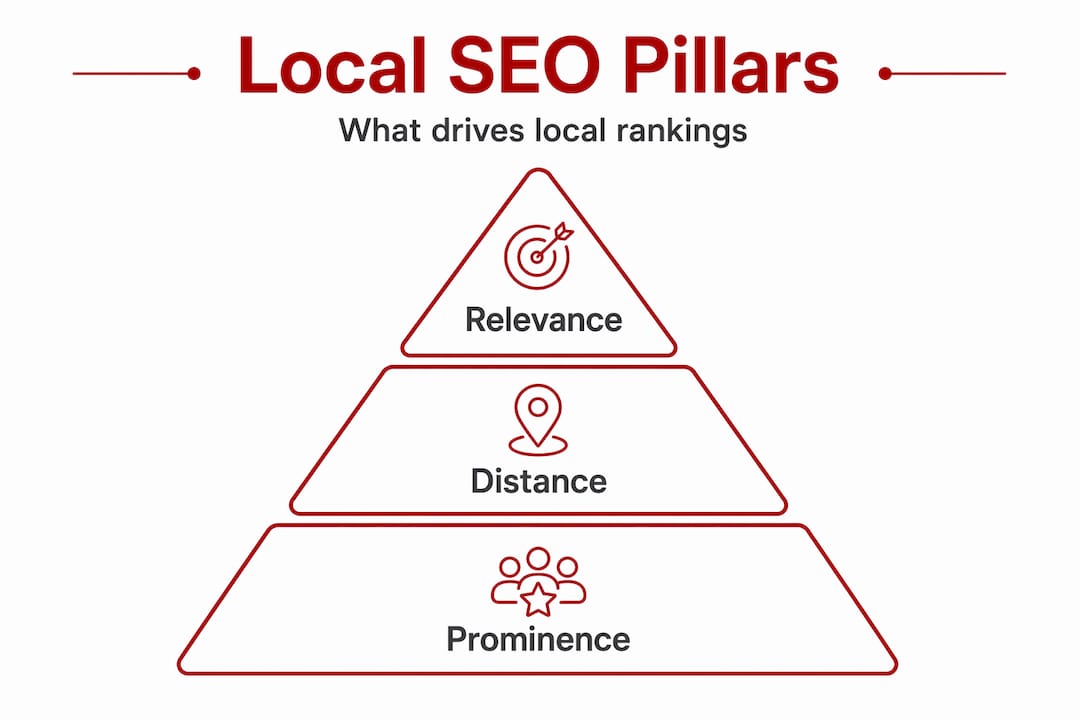
Google uses three core factors to decide which businesses appear in local results. Understanding each one helps you prioritise where to spend your time.
Relevance. This is how well your business listing matches what someone is searching for. If you are a naturopath in Belconnen and someone searches for “naturopath Belconnen,” Google checks whether your profile and website clearly describe that service. Accurate categories, detailed service descriptions, and keyword-rich content on your website all contribute to relevance.
Proximity. This is the physical distance between your business and the person searching. You cannot change your address, but you can make sure Google knows exactly where you are through correct address details in your GBP and on your website. Proximity is the factor you have the least control over, which is why the other two matter so much.
Prominence. This is how well known and trusted your business appears to Google, both online and offline. Prominence incorporates reviews, citations, backlinks, social signals, and the overall quality of your web presence. A business that has been operating for years, has 80 Google reviews, and is mentioned on multiple local websites will outrank a newer competitor with a thin profile, even if they are the same distance from the searcher.
The good news is that relevance and prominence are largely within your control. Accurate business information, thoughtful category selection, and steady review collection all move the needle. Local SEO ranking factors reward businesses that show up consistently and maintain their profiles over time.
Pro Tip: Choose your primary Google Business Profile category carefully. It carries more weight than secondary categories. If you are a general dentist, select “Dentist” not “Medical Clinic.” Specificity helps Google match you to the right searches.
Knowing what local SEO is only gets you so far. What actually moves the needle is applying the right tactics with consistency.
Your GBP is your most powerful local SEO asset. Fill in every field: business name, address, phone number, website, hours, services, and a detailed description. Add real photos of your premises, team, and work. Use the Q&A section to answer common questions before customers need to ask them.
Active GBP management including regular posts, updated hours, and fresh photos compounds your local search performance over time. Think of it like maintaining a shopfront window. Stale or empty signals to Google that you are not engaged.
NAP stands for Name, Address, and Phone Number. Google cross-references your business details across the web to confirm you are who you say you are. Inconsistent NAP data across platforms is one of the most common causes of poor local rankings.

Check that your details match exactly on your website, GBP, social media profiles, and any local directory listings. Even small differences, such as “St” versus “Street,” can create confusion for Google’s systems.
Reviews directly influence both your ranking position and whether a potential customer chooses you. Ask every satisfied client to leave a Google review. Make it easy by sending a direct link. Respond to every review, positive or negative. A thoughtful response to a complaint tells Google and future customers that you are attentive and professional.
Pro Tip: Set a simple routine of asking for reviews after a job is completed or a service is delivered. One or two new reviews per month adds up to a significant advantage over competitors who never ask.
Your website needs to speak the same language as your customers. Use suburb and city names naturally in your page titles, headings, and body copy. A physiotherapy clinic in Tuggeranong should have that location mentioned clearly on its homepage and services pages.
Here is a quick reference for prioritising local SEO website tasks:
| Task | Priority | Time to see results |
|---|---|---|
| Optimise GBP listing fully | High | 2 to 4 weeks |
| Fix NAP consistency across directories | High | 4 to 8 weeks |
| Collect and respond to reviews | High | Ongoing |
| Add local keywords to website content | Medium | 6 to 12 weeks |
| Publish regular GBP posts | Medium | Ongoing |
Local packs vary depending on the search query and the searcher’s exact location. A business that ranks in the 3-Pack for “accountant Civic” may not appear for “accountant Canberra.” Checking your rankings from different locations and for different query variations gives you a clearer picture of where you actually stand.
Many small businesses put effort into local SEO and then wonder why it is not working. Often the answer comes down to a handful of avoidable mistakes.
When your local search optimisation is working well, the results are tangible. You appear in the Local Pack for your key services. Your phone rings more. People walk in or book online because they found you first, not a competitor.
The benefit that is easy to underestimate is intent. Someone searching “emergency electrician Queanbeyan” is not browsing. They have a problem and need help now. Local SEO puts you in front of people at exactly that moment.
“Local SEO connects your business to the community by making you visible for the searches that matter most, the ones where someone nearby is ready to choose.”
There is also a compounding effect. Businesses that build prominence steadily through reviews, citations, and a well-maintained profile become harder to displace over time. That kind of organic visibility does not disappear when an ad budget runs out.
I have worked with enough Canberra small businesses to notice a pattern. Most owners know local SEO matters, but they treat it as something to sort out later. They set up a GBP, get a few reviews in the early months, and then attention drifts elsewhere.
What I have seen is that the businesses consistently showing up in local packs are not necessarily the biggest or the best resourced. They are the ones that show up consistently in the maintenance sense. They update their hours at Christmas. They respond to reviews within a day. They add new photos after a project is done.
The other thing worth saying plainly: local SEO for small businesses is evolving quickly with AI-driven search features and zero-click results changing how people find local services. The basics still matter more than any tactic. A complete, accurate, and active online presence is your foundation. Build that steadily, and the rest becomes much more manageable.
Start with your Google Business Profile. Fix your NAP consistency. Ask for reviews. Then build from there. Small, steady habits create a strong presence over time.
— James
Getting local SEO right starts with having a solid website as your foundation. A slow, outdated, or poorly structured site undermines every other effort you make in local search.

Asporea Digital builds fixed-price WordPress websites for small businesses across Canberra and the Capital Territory, designed specifically to support local visibility and convert visitors into enquiries. Every site is built to load quickly, work properly on mobile, and give Google the clear signals it needs to rank you in the right searches.
Beyond the build, Asporea Digital supports ongoing website management so your site stays current, secure, and optimised as search behaviour evolves. If you are ready to turn your website into a genuine local marketing asset, explore Asporea Digital’s approach to WordPress for local digital marketing or get in touch for a straightforward conversation about your business.
Local SEO is the process of optimising your online presence so your business appears when people search for services or products near them. It focuses on tools like Google Business Profile, local citations, and customer reviews.
Regular SEO targets broad audiences across the web, while local SEO focuses on geographic relevance and intent. Local SEO prioritises appearing in Google’s Local Pack and map results, which regular SEO does not address directly.
Nearly half of Google searches carry local intent, meaning potential customers are actively searching for nearby businesses. Local SEO puts your business in front of those people at exactly the moment they are ready to choose.
Basic improvements like a fully optimised GBP can show results within two to four weeks. Broader ranking gains from consistent reviews and citations typically take three to six months of steady effort.
Your Google Business Profile is the single most impactful element. Keeping it complete, accurate, and actively maintained is the foundation of strong local search performance.

Considering GoDaddy web development service? Read this before locking your business into the wrong website setup.

Domain scams peak during December. Learn how scammers make their emails look real and how to protect your business with simple, practical checks.

Learn how clearer expectations, ownership and communication build a better website relationship.