Blog

Stop Searching Your Business Name: Try This Instead
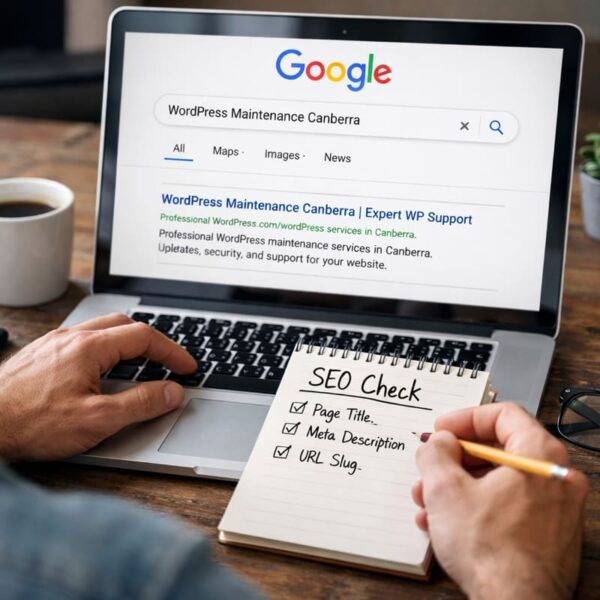
Stop searching your business name. Run a simple SEO check, fix your page title, description and slug, and help strangers find you.

Think of a Web3 domain as the digital equivalent of a personalised number plate that lives in a different registry. Instead of being recorded in the traditional phone book of the internet, it sits in a new kind of ledger that is shared across many computers. Names like yourbrand.eth or yourbrand.crypto belong to this world. People use them to identify themselves, receive crypto payments more safely, and point to web pages that live outside the usual hosting approach.
If regular domains like yourbrand.com are a shop on a busy high street, a Web3 domain is a pop up in a trendy laneway nearby. The pop up is not replacing your shop, and it does not have all the same fixtures, but it can be useful if the customers you care about are walking down that laneway.
A regular domain is rented. You choose a name, pay a registrar each year, and use it for your website and email. The system that makes this work is long established and well governed. It is the reason people can type a name into a browser and reliably reach you. It also comes with the safety rails that large businesses like: clear ownership records, standard security controls, and tested processes for disputes.
A Web3 domain is closer to a digital asset. Ownership usually sits in a digital wallet. Some naming systems are sold as a once off purchase, while others do have renewals, so it is worth checking the fine print before you assume it is “buy once, done forever”. Control depends on who holds the wallet keys. If you lose those keys, you lose control. The name can still point to things on the regular web, but it is most often used as a public identity in the decentralised world, for example to receive funds without sharing a long, error prone wallet address.
Another difference is reach. Regular domains work everywhere without extra steps. Web3 domains work natively in some browsers and apps, and with add ons in others. Think of it as mixed support. Your customers in certain communities will be perfectly comfortable with it. Others will need guidance.
| Feature | Traditional domains (yourbrand.com.au / yourbrand.com) | Web3 domains (yourbrand.eth / yourbrand.crypto) |
|---|---|---|
| Where it lives | In the DNS system managed through registrars and registries | On a blockchain based naming system (depends on the provider and chain) |
| How you get it | You register it through a domain registrar | You mint or purchase it through a Web3 domain provider or marketplace |
| Payment model | Ongoing renewal (usually annual) | Often a once off purchase, though some systems have renewals or fees |
| Ownership control | Account based, managed via your registrar with recovery options | Wallet based, controlled by private keys (lose the keys, lose control) |
| Governance and rules | Mature policies, established standards, clearer dispute pathways | Evolving rules, varying dispute processes depending on the system |
| Transfer and resale | Possible, but usually through registrar processes | Commonly transferable like a digital asset and may be tradable on marketplaces |
| Main purpose today | Website and email, broad compatibility everywhere | Wallet identity, readable payments, onchain identity, sometimes web content |
| Email support | Strong and widely supported | Limited and not an enterprise standard in most setups |
| Browser compatibility | Universal | Mixed: works natively in some apps and wallets, add ons or gateways in others |
| Security focus | Account security, registrar locks, DNS controls | Key management, wallet security, approval workflows |
| Recovery if access is lost | Often recoverable through registrar processes (depending on controls) | Typically not recoverable if the private keys are gone |
| Best fit for businesses | Any business that needs reliable web presence and email | Businesses with crypto users, Web3 communities, or brand protection needs |
| Practical role | Your main street shopfront | A lane way presence for specific audiences and use cases |
Brand protection is the first reason. If there is a chance your name will matter in crypto friendly circles, claiming the obvious Web3 version of your brand is a simple defensive move. It is the same logic as securing social handles early.
Convenience is the second. If you take donations, sponsorships, or payments in crypto, asking people to send funds to yourbrand.eth is easier and far less error prone than pasting long strings of characters. Finance teams also gain a clear, consistent label to publish on official channels.
Signalling is the third. In some markets, using a Web3 name tells your community you are open to new ways of engaging. Used sparingly, it can support an innovation message without changing your core presence.
A few well known names have already treated Web3 domains as brand real estate, either for visibility, experimentation, or future proofing.
PUMA registered and referenced its ENS name as part of its Web3 activity, marking it as an early mainstream mover in this space.
Budweiser purchased the ENS name beer.eth, which is basically the corporate version of putting your name on a locker in the metaverse.
Uniswap rolled out uni.eth usernames (subdomains built on ENS infrastructure) so users can use readable identifiers instead of clunky wallet addresses.
GoDaddy and ENS have pushed the “bridge” idea further by letting customers connect traditional DNS domains to ENS functionality, effectively giving everyday domains a crypto friendly identity layer.
The pattern is consistent: nobody sensible is binning their .com, but plenty are quietly reserving the laneway spot.
A Web3 domain does not replace your .com. It will not run your email in a way an enterprise would accept, and it will not fix a clunky website. Support across countries and browsers varies. Dispute processes exist in some naming systems but they are not as mature as the traditional world.
Most importantly, the human risk shifts from forgetting to renew a name to mishandling a wallet. People misplace passwords. People leave companies. Keys need governance.
If a Web3 domain is controlled by a wallet, then security mostly comes down to one thing: who holds the keys, how they’re stored, and what happens when something changes. The good news is you do not need complicated technology to improve your risk position. A few sensible habits make a big difference.
The first shift is to treat the domain like a business asset, not a marketing experiment. That means keeping a simple internal record of what you own, where it lives, who is allowed to change it, and what it is actually used for. It sounds almost too basic, but most messy incidents start with, “we thought someone else had it” or “we didn’t realise it was pointing there”.
From there, the biggest practical step is avoiding the single person wallet setup. If one person holds the only keys, you are one lost phone, one phishing message, or one awkward resignation away from a problem. A better approach is shared control, where important changes need approval from more than one trusted person. Think of it like requiring two signatures on a bank transfer. It is not glamorous, but it stops both honest mistakes and the rare but painful internal drama.
How the keys are stored matters too. If the wallet holding the domain is sitting on a laptop that also downloads random attachments, you are playing security roulette. Using a hardware wallet is one of the simplest ways to reduce the risk of malware or a convincing fake login page taking control. It is not perfect, but it raises the difficulty level for attackers significantly.
It also helps to separate who requests changes from who approves them. In a small business, that might just mean one person proposes updates and another person checks and confirms before anything is published. In a larger team, it might be marketing working with IT or a nominated security owner. Either way, you are creating a pause point where someone can spot a wrong address, a dodgy request, or a change that does not match what the business intended.
The uncomfortable but important bit is planning for people changes. If a key holder leaves, you need a clear path to maintain access and ownership. That means having documented recovery steps and secure backups that are actually retrievable, rather than a seed phrase saved in a notes app or a photo album next to the dog pictures. If you would not store your banking credentials that way, do not store your domain keys that way either.
Finally, keep an eye on the settings that matter most. The riskiest moments are usually when the domain’s resolver is changed, because that is what controls where the name points and which wallet it resolves to. You do not need a security operations centre to handle this, but you do want a simple change process and a way to spot unexpected updates quickly.
One last tip: publish your official Web3 domain where people already trust you. Putting it on your .com site makes it easy for customers to verify they have the right name, and it makes impersonation harder. And if you choose to connect a traditional domain into a Web3 naming system, remember you are now relying on the security of your DNS setup too. In other words, keep your normal domain house in order, because you are building the new thing on top of it.
This space is still early, but the direction of travel is becoming clearer. Rather than Web3 domains swooping in to replace the existing internet, the more likely outcome is a gradual blur between the two worlds. In practice, that looks less like “goodbye DNS” and more like layering a wallet friendly identity on top of the naming system everyone already uses, but only where it actually adds value.
Payments are the obvious first step because they solve a real annoyance straight away. The more interesting shift may come from identity. If a domain can act like a readable, portable username, it can also become a way to sign in, prove ownership, and carry a consistent profile across apps without needing a new account every time. That idea is already bubbling away in the background of a lot of Web3 products, even when it is not marketed loudly.
Support will probably improve, but it will do so unevenly and in bursts. Some browsers and wallets will make these names feel almost normal, while others will continue to treat them as something you need an extra step for. Over time the friction should shrink, but it is unlikely to disappear overnight, which is why it still makes sense to treat Web3 domains as an additional layer rather than the front door to your business.
For businesses, a practical direction is not just owning a single name, but using sub identities for specific groups: customers, staff, members, creators, or loyalty communities. It is the same logic as giving people a simple membership number or a personalised referral link, except it is tied to a wallet and can travel across platforms. Done well, it reduces copy paste errors and makes the experience feel more human.
As the space attracts more mainstream brands, the governance side will keep tightening up too. Once real money and real reputations are on the line, custody models, recovery processes, and enterprise grade controls tend to arrive whether anyone thinks they are exciting or not. That is usually a good sign, even if it is not exactly the part you put on the brochure.
Start small and treat this as a controlled pilot. Pick the naming system that your customers actually use. Secure the exact brand match and a small number of obvious lookalikes. Store the asset in a secure setup with more than one person involved in access. Publish the official name on your .com so customers can verify it. Then use it for one clear purpose, such as receiving funds or identifying your brand in a specific community. After a few months, review whether it made life easier or simply added noise.
Ask one question first: do the customers you care about use crypto or take part in Web3 communities today? If the honest answer is no, park the idea and focus on your main site. If the answer is yes, or even “some of them,” then a light touch approach makes sense. Secure your brand name, set up safe custody, publish it clearly, and keep the use case narrow.
Web3 domains are like a new kind of business card for the decentralised side of the internet. They live in a different registry, are controlled by a digital wallet, and are most useful for simple identification and payments in communities that already use them. They are not a replacement for your main domain and email. If you try them, do it for a clear reason, keep the risk low, and put proper key governance in place so your cool new laneway pop up does not turn into an incident report.
If you want to explore Web3 domains without turning your core website into a science experiment, Asporea Digital can help you plan a light touch approach that protects your brand and keeps the risk sensible. If you need reliable hosting for your main site, we can also sort that through Asporea Hosting.

Did you enjoy this read? Release Notes is a newsletter that lands in your inbox once a month with one focused idea, a quick how to, and a tiny check to measure progress. Subscribe to get a monthly note focused on better site management, optimised websites and steps you can take to make your site more secure.
Short reads, real results.
Stop searching your business name. Run a simple SEO check, fix your page title, description and slug, and help strangers find you.

Why authors should own their domain name, protect book sales pathways, and avoid publisher control over their online brand.

Squarespace site not pulling its weight? A Tune Up can sharpen copy, layout, SEO and enquiry paths without starting again.
No matching results found
[asporea_chat]