
Blog

9 Signs You’re Ready to Build a Membership Site
9 signs you’re ready to build a membership site and turn your content into a structured, income generating online business.

TL;DR:
- Qualified website traffic is vital, focusing on attracting interested visitors through SEO, content, social media, and targeted ads. Consistently optimizing long-tail keywords, refreshing existing content, and combining organic and paid strategies build sustainable growth over time. Regularly measuring engagement, conversions, and search performance ensures small businesses attract the right audience and achieve long-term success.
Increasing website traffic means attracting more qualified visitors through a deliberate mix of SEO, content creation, social media, and targeted advertising that aligns with your business goals. For small business owners, the challenge is not simply getting more people to your site. It is getting the right people there. Tools like Google Search Console, Google Analytics, and platforms such as WordPress give you the data and structure to make that happen. This guide walks you through the strategies that work, how to apply them in a practical order, and what realistic results look like for an Australian SMB in 2026.
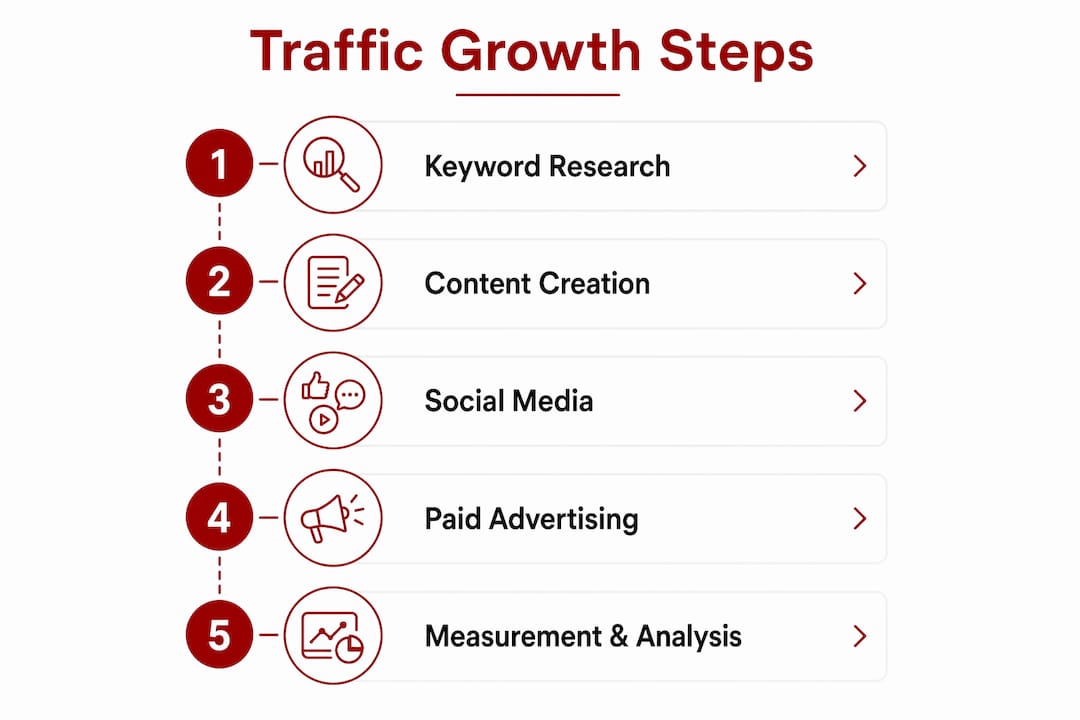
Qualified traffic matters far more than raw visitor numbers. A hundred visitors who are genuinely interested in your service are worth more than ten thousand who bounce in seconds. With that principle in mind, the following strategies consistently deliver results for small businesses.
Pro Tip: Start with one or two strategies and do them consistently before adding more. Spreading effort too thin across five channels at once produces mediocre results on all of them.
The most effective approach combines long-term organic assets with controlled paid tests. This dual-engine method reduces reliance on any single source and keeps traffic flowing even when one channel dips.
Keyword research is the foundation of any strategy to increase site visitors from search. The goal is to find terms your ideal customers actually type into Google, then build pages that answer those queries better than anyone else.
Here is a practical process to follow:
Pro Tip: Before writing new content, check which of your existing pages rank in positions 4 to 15 on Google. Refreshing those pages with updated information, better headings, and stronger internal links often moves them to page one faster than publishing something brand new.
| Optimisation task | Expected benefit |
|---|---|
| Target long-tail keywords (volume under 30) | Higher chance of ranking for a small or new site |
| Prioritise high CPC keywords | Attracts visitors with stronger purchase intent |
| Refresh pages ranked positions 4 to 15 | Faster path to page one than creating new content |
| Improve site speed and mobile performance | Reduces bounce rate and supports Google ranking |
| Build internal links between related pages | Strengthens site architecture and session duration |
For Canberra-based businesses, local SEO tactics add another layer of relevance. Appearing in local search results for terms like “physiotherapist Belconnen” or “electrician Tuggeranong” puts your business in front of people who are ready to act.
Content and social media work together as a long-term engine for organic growth. One creates the asset; the other distributes it. Neither works as well in isolation.

Evergreen content is the most reliable traffic driver over time. A well-written guide that answers a common customer question will attract visitors for years without needing constant updates. Content clusters and pillar pages take this further by grouping related articles around a central topic, which helps both Google and AI-powered search tools recognise your site as an authority in that area.
Here is how to build a content and social media approach that compounds over time:
Social media does not replace SEO. It amplifies it. When your content gets shared, it earns more visibility, more backlinks, and more traffic. The two channels reinforce each other when you treat them as a system rather than separate tasks.
Paid advertising is not a shortcut to sustainable traffic. It is a tool for speed and testing. Used well, it fills the gap while your organic channels build and gives you real data about what messaging resonates with your audience.
Follow this sequence to get the most from a small paid budget:
Leveraging micro-moments — the brief windows when someone is actively searching for a solution — can increase total site visits meaningfully. This is where paid search ads are particularly effective, because they put your business in front of someone at the exact moment they are looking.
The most sustainable approach combines organic and paid channels. Organic builds the foundation; paid accelerates specific goals. Neither replaces the other.
Measuring your traffic is not just about watching numbers go up. It is about understanding which visitors are worth attracting and whether your site is converting them into real enquiries.
Google Analytics is the standard tool for tracking traffic sources, user behaviour, and conversion events. Set it up from day one and check it regularly, not just when you are worried something has gone wrong. Cross-channel analytics reduce wasted effort by showing you which channels are genuinely contributing to business outcomes.
The metrics worth prioritising are engagement rate, return visit rate, and conversion rate. These tell you whether visitors find your content useful and whether your site is doing its job. Raw pageview counts are satisfying but misleading if the visitors are not the right ones.
| Metric | What it tells you |
|---|---|
| Engagement rate | Whether visitors are reading and interacting, not just landing and leaving |
| Return visit rate | Whether your content is building a loyal, returning audience |
| Conversion rate | Whether traffic is translating into enquiries, bookings, or sales |
| Traffic source breakdown | Which channels are driving the most valuable visitors |
Pro Tip: Review your Google Search Console data monthly. It shows exactly which search queries are bringing people to your site, which pages are ranking, and where you have opportunities to improve. It is one of the most underused free tools available to small business owners.
Sustained growth comes from regular maintenance, not one-off efforts. Update older content, fix broken links, check your site speed, and review your keyword rankings on a consistent schedule. Small, steady habits create a strong foundation for long-term visibility.
Increasing website traffic for small businesses requires a consistent combination of targeted SEO, quality content, social media distribution, and measured paid advertising rather than any single tactic.
| Point | Details |
|---|---|
| Prioritise qualified traffic | Focus on attracting visitors with genuine interest in your service, not just volume. |
| SEO takes 3 to 6 months | Set realistic expectations and start early so organic traffic builds steadily. |
| Refresh before you create | Update pages ranked in positions 4 to 15 before writing new content for faster results. |
| Combine organic and paid | Use paid ads to test and accelerate while SEO and content build long-term momentum. |
| Measure what matters | Track engagement, return visits, and conversions rather than raw pageview counts. |
Working with small businesses in Canberra and the Capital Territory, I have seen the same pattern repeat itself. A business owner invests in a new website, waits a few weeks, and then wonders why the phone is not ringing. The website is not the problem. The absence of a traffic strategy is.
The honest truth is that traffic growth is rarely the result of secret tricks. It comes from doing the fundamentals well and doing them consistently. SEO, content, and a modest paid budget applied steadily over six to twelve months will outperform any shortcut.
What I caution against most is chasing volume. I have seen businesses celebrate a spike in traffic that produced zero enquiries, because the visitors were never the right audience. The goal is always qualified visitors. Someone searching for “WordPress website designer Canberra” is worth a hundred people who stumbled onto your site from a generic social post.
Start with one channel, do it properly, and then add the next. A well-structured WordPress site with solid local SEO foundations and a consistent blog will outperform a business trying to manage Google Ads, TikTok, LinkedIn, and a podcast simultaneously with no clear strategy. Simplicity, applied with patience, wins.
— James
If you are a small business owner in Canberra or the Capital Territory and you want a website that actually attracts and converts visitors, Asporeadigital builds fixed-price WordPress websites designed around your business outcomes.
From WordPress and digital marketing strategy through to SEO improvements, content direction, and ongoing site support, Asporeadigital gives you one local team that handles everything. No passing you between providers. No vague advice. Just clear, practical support from someone who understands the Canberra market. Explore how effective homepage design can turn your traffic into real enquiries, or get in touch to discuss your site today.
Most websites see measurable results from SEO within 3 to 6 months of consistent effort. Paid advertising delivers traffic immediately but requires ongoing budget to maintain.
SEO combined with regular blog content is the most effective free method for sustained traffic growth. Google Search Console and Google Analytics are free tools that help you track and improve your results.
Use both, but in the right order. Build your SEO and content foundation first, then use paid ads to test offers and accelerate specific campaigns. Relying solely on paid ads is costly and stops working the moment your budget ends.
Target long-tail keywords with search volume under 30 and a cost-per-click of $5 or higher. These terms attract visitors with clear purchase intent and give smaller sites a realistic chance to rank on page one.
Track engagement rate, return visit rate, and conversion rate in Google Analytics rather than raw pageview counts. These metrics show whether your visitors are the right audience and whether your site is turning them into enquiries or sales.

9 signs you’re ready to build a membership site and turn your content into a structured, income generating online business.

Buying a domain is only step one. This plain English guide explains hosting, why builders like Wix can become limiting, and the smarter way to

Clubs are moving membership renewals online to reduce admin, free up front desk staff and make dues, payments and member updates easier to manage.