
Performance and Systems

Why Does Email Get More Expensive Without Getting Better?
As email lists grow, pricing increases and platforms become harder to use, even though the work stays the same. This article looks at why that

TL;DR:
- A structured content creation workflow helps small businesses grow organic traffic, generate leads, and maintain consistency without burnout. Developing clear briefs, separating drafting from editing, and tracking performance are key to sustainable content strategies. Regular reviews and repurposing ensure continuous improvement and maximize content ROI.
The content creation process is a structured workflow that moves an idea from a blank page to a published asset that earns traffic, builds trust, and generates enquiries. Documented strategies double publication speed and are linked to 55% organic traffic growth among small businesses. That figure matters because it shows a clear system is not a luxury for large marketing teams. It is the single most practical thing a small business owner can do to grow their online presence steadily and without burning out.
The content creation process is the sequence of decisions and actions that turns a topic idea into finished, published content. It covers planning, briefing, drafting, editing, publishing, and measuring. Each stage has a defined purpose, and skipping any one of them is where most small business content falls apart.
Content fails without early decisions on audience and purpose. A tradie in Canberra writing a blog post without knowing whether it is aimed at homeowners or property managers will produce something vague that satisfies neither. Clarity on who you are writing for and what you want them to do next is the foundation every other step rests on.
The term “content creation process” is widely used, but the recognised industry term is content production workflow. Both describe the same thing. Using both helps you communicate clearly whether you are talking to a marketing consultant or reading a platform guide.
Before you write a single word, three things need to be in place: a clear audience profile, a list of topics aligned to what that audience searches for, and a simple system to track what gets created and when.
The tools do not need to be expensive. Most small businesses manage well with:
Advanced SEO workflows group related keywords into clusters, targeting 20 to 50 or more related terms per pillar piece of content. For a small business, this means writing one strong article on a core topic and then creating shorter supporting pieces that link back to it. This approach builds authority in search without requiring you to produce an overwhelming volume of content.
Pro Tip: Score your topic ideas in a simple spreadsheet using three columns: search volume (low/medium/high), relevance to your service, and how quickly you could write it. Prioritise topics that score well across all three. This turns a chaotic idea list into a clear production queue.
A content brief is the contract between the person planning the content and the person writing it. When you are both the same person, it still matters. Writing a brief forces you to make decisions before you start drafting, which prevents the most common cause of wasted time: writing something and then realising halfway through that you are not sure what point you are making.
A detailed brief that defines angle, keywords, audience, format, and length avoids wasted drafts and revisions. A good brief takes ten minutes to write and can save an hour of rewriting. Every brief should answer six questions before drafting begins.
The difference between a thin brief and a solid one is the difference between a piece that gets published once and forgotten, and one that earns traffic for years.
| Characteristic | Thin brief | Solid brief |
|---|---|---|
| Audience definition | “Small business owners” | “Canberra service businesses with 1 to 5 staff” |
| Keyword guidance | “SEO stuff” | Primary keyword plus three related terms with intent noted |
| Format and length | Not specified | Blog post, 900 to 1,100 words, with one comparison table |
| Key points | “Cover the topic” | Five specific points listed with preferred order |
| Call to action | Missing | “Link to booking page, encourage a free consultation” |
Pro Tip: Assign a named owner and a fixed briefing deadline for every piece of content, even if that owner is you. Accountability to a calendar date is more reliable than motivation alone.
The production workflow has four stages: plan, produce, polish, and publish. Each stage should have a time limit attached to it. Without time limits, content sits in draft indefinitely.
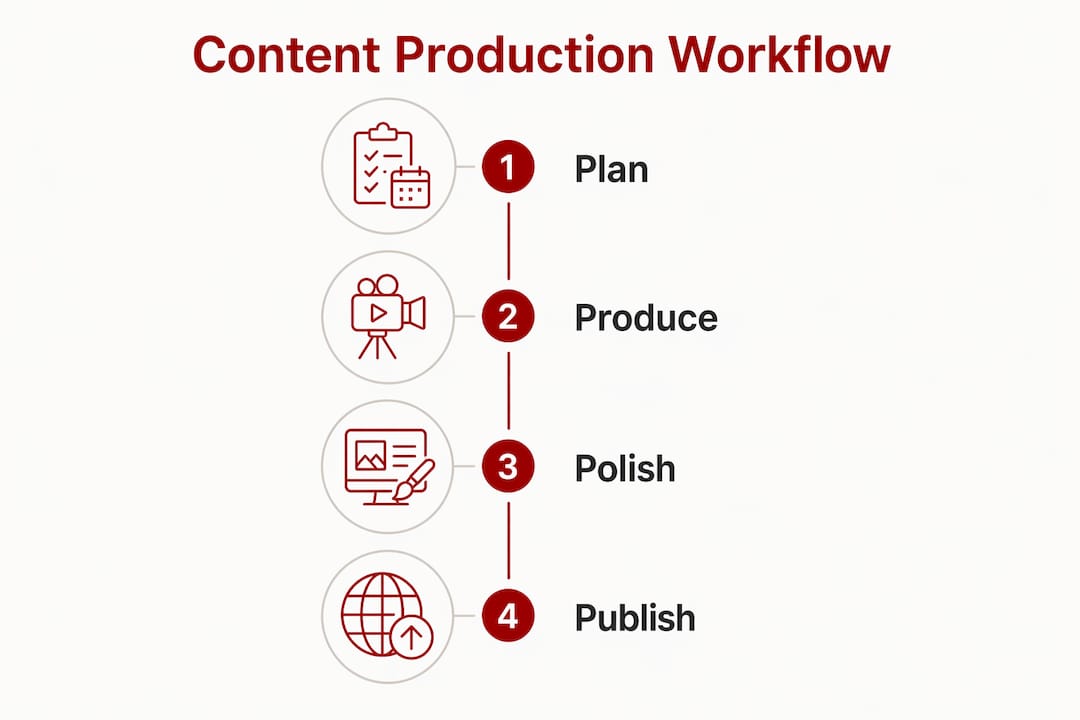
Stage 1: Plan. This is where the brief is written and approved. For a solo operator, “approved” means you have reviewed it the next morning with fresh eyes and confirmed it still makes sense.

Stage 2: Produce. Write the draft without stopping to edit. Perfection paralysis causes many creators to delay publishing. The solution is to separate drafting from editing entirely. Set a timer, write to the brief, and stop when the timer ends.
Stage 3: Polish. Editing goes beyond fixing grammar. Editing extends beyond grammar to verifying argument alignment and factual accuracy, and is ideally done by a separate reviewer. If you are a one-person operation, leave the draft for at least a few hours before editing. Distance from the draft makes errors easier to spot. Use Grammarly for surface-level checks and Hemingway Editor to flag sentences that are too long or passive.
Stage 4: Publish. Publishing is not the end of the workflow. It is the handoff to distribution. Effective content distribution assigns roles to channels: blogs focus on SEO and authority, social media builds engagement, and email nurtures leads. A single blog post can become a social caption, an email newsletter section, and a short video script without writing anything new.
Common workflow pitfalls and how to handle them:
Pro Tip: Batch content creation and reuse pillar content across formats to save time and maintain consistent output. Block one morning per fortnight to write three briefs and one full draft. This rhythm is more sustainable than trying to produce content reactively.
Publishing content without tracking its performance is the equivalent of running a promotion and never checking whether it brought in customers. The measurement stage closes the loop and tells you what to do more of.
For most small businesses, three metrics cover the essentials:
A simple Google Sheets dashboard with one row per published piece, updated monthly, is enough to spot patterns. Which topics bring traffic? Which pages convert visitors into enquiries? Which formats get shared? Those answers tell you where to focus your next production cycle.
| Metric | What it tells you |
|---|---|
| Organic traffic per page | Whether the content ranks and attracts search visitors |
| Conversion rate from content | Whether the content turns readers into leads or customers |
| Time on page | Whether readers are engaging with the content or leaving quickly |
| Returning visitors | Whether your content builds an audience over time |
Repurposing is the most underused part of the content workflow for small businesses. A well-performing blog post can become a local SEO asset, a social media series, or the basis of a new service page. Review performance quarterly and make repurposing decisions based on data, not guesswork.
A structured content production workflow is the single most reliable way for small businesses to grow organic traffic, generate leads, and publish consistently without burning out.
| Point | Details |
|---|---|
| Document your strategy | Documented strategies are linked to faster publishing and measurable traffic growth. |
| Write a brief before every piece | A solid brief prevents wasted drafts and keeps content aligned to audience and goals. |
| Separate drafting from editing | Treating these as distinct stages reduces perfection paralysis and improves output quality. |
| Distribute across channels intentionally | Match content to channel purpose: blogs for SEO, social for engagement, email for leads. |
| Review and repurpose regularly | Quarterly performance reviews reveal what to repeat, improve, or repurpose for greater reach. |
Most small business owners I speak with know they should be producing content. The hesitation is rarely about motivation. It is about not knowing where to start, and then feeling like the whole thing is too complicated to maintain alongside running an actual business.
The businesses that get traction are not the ones producing the most content. They are the ones that have made the process boring in the right way. They have a template, a calendar, a brief format, and a publishing rhythm. Content creation is more muscle memory than magic, and routine reduces overwhelm. Once the system is in place, producing a solid piece of content takes a fraction of the time it did when everything was started from scratch.
The mistake I see most often is treating quality and consistency as opposites. They are not. A 700-word post that answers one question clearly and links to a relevant service page will outperform a 2,000-word piece that tries to cover everything and gets abandoned halfway through editing. Start smaller than you think you need to. Publish it. Check what happens. Adjust. That cycle, repeated steadily, is what builds a content presence that actually supports WordPress content marketing and long-term growth.
— James
If you have been putting off content because the process feels unclear or time-consuming, a well-structured website gives you the foundation to make it work. Asporeadigital builds WordPress websites for Canberra small businesses that are designed to support steady content growth, local search visibility, and real enquiries.

From service pages to blog structures and SEO-ready content frameworks, Asporeadigital sets up your site so that every piece of content you publish has the best chance of being found and acted on. Read the WordPress digital marketing guide to see how a well-built site supports your content efforts from day one.
A content creation process for small businesses is a repeatable workflow covering planning, briefing, drafting, editing, publishing, and measuring. It replaces ad hoc content decisions with a structured system that produces consistent output aligned to business goals.
Most effective content production workflows follow four stages: plan, produce, polish, and publish. Each stage should have a named owner and a time limit to prevent bottlenecks and keep content moving toward publication.
A content brief defines the audience, keyword focus, format, length, key points, and call to action before drafting begins. Briefs act as contracts between planners and writers, turning vague ideas into structured content plans that require fewer revisions.
A quarterly review is sufficient for most small businesses. Check which pages are generating traffic and leads, identify underperforming content for improvement, and decide which pieces are worth repurposing into new formats or channels.
Batch creation and brief templates are the two highest-impact changes a solo operator can make. Writing three briefs in one session and then drafting from them across the week is significantly faster than starting each piece from scratch with no preparation.

As email lists grow, pricing increases and platforms become harder to use, even though the work stays the same. This article looks at why that

Many Canberra businesses think they own their domain name when they don’t. Learn how to protect your brand and keep control of your website with

Stop getting silence after you hit send. Use an AI Assisted Automated Response that reflects the enquiry and buys time properly.