
Blog

Broken Up With Your Web Developer?
Learn how clearer expectations, ownership and communication build a better website relationship.

TL;DR:
- Community websites serve as digital town squares where locals connect, share resources, and build trust effectively. They thrive through thoughtful governance, purposeful design, and hybrid moderation combining AI with human judgment. Prioritizing community culture over technology ensures sustainable engagement and meaningful local impact.
Most people assume a community website is just a forum with a local postcode attached. That framing undersells what these platforms actually do. The role of community websites reaches well beyond discussion boards. At their best, they act as digital town squares where locals find services, share resources, attend events, and build the kind of trust that usually takes years to develop in person. Research from 2026 confirms that active community members report 23% lower loneliness scores than those who disengage. That figure alone should change how individuals and organisations think about building and maintaining these platforms.
| Point | Details |
|---|---|
| More than just forums | Community websites function as hubs for connection, resource sharing, events, and local engagement. |
| Governance shapes culture | Clear rules set before joining are more effective than reactive moderation at building trust. |
| Technology is a tool, not a solution | AI helps with scale, but human judgement is still required for nuanced moderation decisions. |
| Start with purpose, not platform | Clarity of shared purpose from day one determines whether a community website thrives or stalls. |
| Ownership matters | Dedicated owned platforms reduce reputational risk and give organisations far greater control over culture. |
A community website does three things well when it is designed thoughtfully. It connects people, keeps them engaged, and gives them something useful to come back for.
Connection happens through the structural features of the platform. Member profiles, direct messaging, and event registration give people a reason to show up and a way to interact once they do. These are not passive features. When someone can see who else is in their suburb, join a conversation about a local issue, or RSVP to a community working bee, the platform becomes a genuine social touchpoint.
Engagement is built through forums, polls, user-generated content, and recurring events. The impact of community forums on day-to-day participation is well documented. Small online groups of between 10 and 50 members provide social support comparable to traditional neighbourhood ties. That finding shifts the goal from chasing large membership numbers to cultivating genuine participation within a focused group.
Resource sharing is where many community websites deliver their clearest practical value. Consider:
When these features work together, the benefits of online communities extend well beyond the screen. A family new to Canberra can find a reliable electrician, a neighbourhood Facebook group-equivalent with less noise, and a local sporting club all in the same place. That kind of consolidated local value is difficult to replicate anywhere else.
A platform without structure quickly becomes a place people leave. The way community websites handle governance, from the moment someone joins to how conflicts are resolved, determines whether the community becomes a trusted resource or a liability.

The most effective approach sets expectations before anyone joins. Pre-joined agreements about conduct are more effective at shaping culture than reactive moderation after the fact. This means spelling out community standards clearly on the registration page, not buried in terms and conditions nobody reads.
Good governance also depends on human judgement. Volunteer moderators who understand the community’s context and shared values provide something no automated system can. They recognise when a heated post is frustrated venting versus a genuine threat. They know which members tend to de-escalate conflict and which ones tend to amplify it. That local knowledge is part of what makes a well-governed community website worth belonging to.
As one useful framing puts it, community is the trust inside the container, not the container itself. The technology sets the boundaries, but the culture determines whether people actually want to be there.
Pro Tip: Draft your community standards in plain language before you launch anything. Ask a few founding members to read them aloud. If a rule sounds confusing or harsh out of context, rewrite it until it sounds like something a reasonable person would agree to.
Unmoderated public spaces tend to attract exactly the kind of behaviour that drives good members away. Owned and governed platforms reduce that risk considerably. Controlled branded communities reduce legal, ethical, and reputational risks that are unavoidable on open social media. For organisations, this is not just a community benefit. It is a sound risk management decision.
The platforms people use to build and manage community websites have changed considerably. AI tools now handle the parts of moderation that would otherwise overwhelm a small volunteer team.
The challenge is knowing what AI can and cannot do. AI tools enhance moderation but cannot replace human judgement in nuanced community management. A hybrid approach, where automation flags content for review and humans make the final call, is currently the most reliable model. Think of it as AI handling the queue while a person handles the verdict.
“Combining automation for initial detection with human-modulated decisions based on context is essential to balance trust and scale in online community moderation.”
Alongside moderation, the content quality question has become more pressing. As AI-generated posts become harder to detect, verified human knowledge is now the primary value of community websites. For health communities specifically, a practical response is implementing a three-source rule, requiring that any health information shared be backed by at least three credible references before it is promoted within the platform.
The table below compares two approaches to managing community website technology:
| Feature | AI-only moderation | Hybrid moderation |
|---|---|---|
| Speed of content review | Fast | Moderate |
| Nuanced decision-making | Low | High |
| Member trust | Lower over time | Higher over time |
| Volunteer workload | Low | Medium |
| Error rate on edge cases | High | Low |
Design choices also matter. Platforms that prioritise membership and content quality over advertising scale create more sustainable engagement. A community website that charges a modest membership fee and curates its content carefully will often outlast a free-for-all platform that relies on volume to generate revenue. The incentives are simply better aligned with long-term community health.
Tools like AI chatbot features can also support participation, helping members find information quickly and reducing the load on human administrators for routine enquiries.
If you are setting up a community website or trying to get more value from one that already exists, the following sequence tends to work well in practice.
Pro Tip: The easiest way to kill a new community website is to let it go quiet for two weeks. Plan at least one piece of content or one prompt per week for the first three months, even if it is just a question you post yourself.
Common pitfalls include launching with too many features, failing to appoint a clear lead moderator, and treating the platform as a set-and-forget system. None of those habits serve the people you are trying to bring together. The importance of community websites lies not in the technology but in the ongoing human attention that keeps them relevant and safe.
Not every community website needs to be built the same way. The right format depends on your goals, your audience, and how much control you need over culture and content.
| Format | Best for | Governance control | Reach | Monetisation options |
|---|---|---|---|---|
| Standalone membership site | Professional associations, member organisations | High | Moderate | Subscriptions, event ticketing |
| Social media group | Casual local interest groups | Low | High | Limited |
| Purpose-built community platform | Specialist or niche communities | Medium to high | Variable | Memberships, sponsorships |
| Local council or not-for-profit site | Broad civic engagement | High | High | Grant-funded |
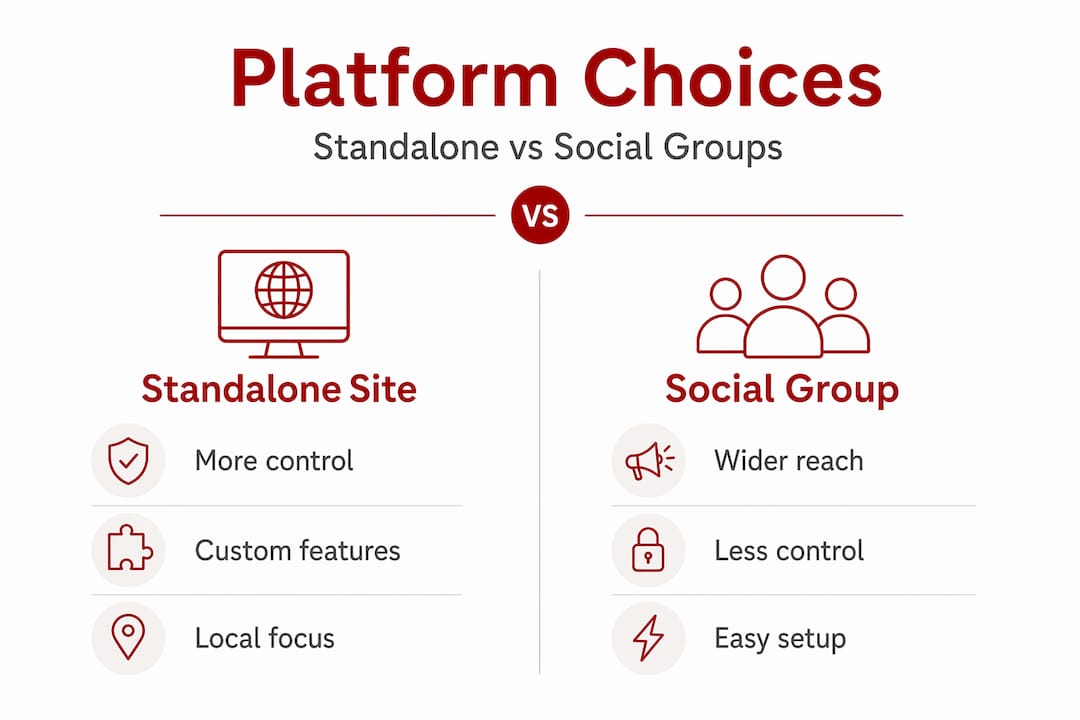
Standalone sites and purpose-built platforms give you the most control. Social media groups trade that control for reach. For organisations where owning your community spaces is a strategic priority, the investment in a dedicated platform pays off in reduced risk and stronger long-term culture.
I have seen organisations pour resources into building platforms and then wonder why nobody shows up. The common thread is almost always the same. They built the container before they understood the community.
In my experience, the most effective community websites begin with a conversation, not a website brief. Someone identifies a genuine gap. A group of people with that same problem find each other. Then, and only then, does the question of technology become relevant.
What I find particularly striking is how community sites connect people in ways that social media never quite manages. Social platforms are designed for broadcast. Community websites, when built well, are designed for dialogue. That distinction matters enormously for how people feel when they use them.
I have also noticed that organisations which treat their community website as a core asset, something they actively manage and protect, tend to see the strongest outcomes. They appoint moderators. They review governance. They respond to members quickly. They treat website support as a non-negotiable part of running the platform, not an afterthought.
My honest advice is this: prioritise trust and culture before you think about features. A simple platform with a committed, well-governed community will outperform a sophisticated one that nobody trusts.
— James
If you are a Canberra-based organisation ready to build or improve a community website, Asporea Digital can help you get it right from the start. From custom WordPress development tailored to your specific community structure, to membership features, forum integration, and ongoing governance support, the team builds platforms that are practical, well-maintained, and designed for real engagement.
Asporea Digital also provides website management services to keep your community platform secure, updated, and performing well long after launch. Fixed pricing, local support, and a clear process mean you know what you are getting before work begins. Reach out to discuss your community website project today.
Community websites serve as digital hubs for local connection, resource sharing, and engagement. They help people find services, participate in discussions, and build trust within a defined group or geography.
They use member profiles, forums, event listings, and shared directories to give people structured ways to interact. Small, focused groups of 10 to 50 members have been shown to provide social support comparable to traditional neighbourhood ties.
The benefits include reduced social isolation, practical resource sharing, improved local visibility for organisations, and a governed space for dialogue. Active members in health-focused communities reported 23% lower loneliness, according to 2026 research.
The most effective approach combines clear rules at the point of joining with a hybrid moderation model. AI tools assist with scale but human moderators are needed for nuanced decisions.
Organisations that need governance control, reduced reputational risk, and sustainable monetisation are better served by dedicated owned platforms. Social media groups offer reach but limited control over culture and content.

Learn how clearer expectations, ownership and communication build a better website relationship.

Squarespace site not pulling its weight? A Tune Up can sharpen copy, layout, SEO and enquiry paths without starting again.

Build your online profile early to turn experience into coaching, courses, mentoring and new income before you need it fast.