Blog

Your Contact Page Should Feel Like an Open Door
Many websites lose leads on the contact page. Uncover the most common mistakes and how to design a page that builds confidence and action.

Most small business owners have a website because they know they need one. That part is straightforward enough. A potential customer hears about the business, looks it up, and expects to find something credible. A website now sits in the same category as a business phone number or an email address. It is part of being taken seriously.
The problem is that many websites stop there.
They exist. They look decent. They say the right sort of things. They confirm that the business is real and apparently open for business. Beyond that, though, they often do very little. They do not explain the offer clearly enough. They do not help the right people move towards an enquiry or a sale. They do not answer the questions that hold buyers back. They do not give the business much real leverage. They simply sit there, looking presentable and underperforming in a quiet, well-mannered sort of way.
A lot of small business owners sense this already. They may not phrase it quite like that, but they know the website should be earning its keep more convincingly. They know it ought to be bringing in better enquiries, supporting sales more effectively, or at least making life easier when a prospect lands on the site. Instead, it often behaves like a polite digital brochure. It introduces the business, nods courteously at the visitor, and then leaves them to work out the rest for themselves.
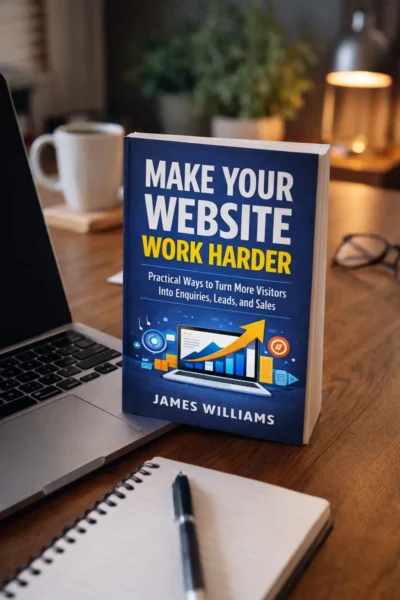
That is exactly why I wrote Make Your Website Work Harder: Practical Ways to Turn More Visitors Into Enquiries, Leads, and Sales.
I wrote it for small business owners who want a more grounded and useful way to think about their website. Not as a design project. Not as an online box-ticking exercise. Not as a vague “presence”. As a working part of the business.
Because that is what a website should be.
A useful website helps the right people understand what you do, why it matters, and what they should do next. It helps a referred prospect decide whether to get in touch. It helps a buyer feel confident enough to make a purchase. It helps a business explain itself properly before the first phone call ever happens. It supports trust. It supports sales. It supports action. When it is doing that well, the business feels the difference.
What I have found, both in practice and in conversation with business owners, is that most people do not need more digital jargon. They do not need another breathless article about “crushing it online” or a maze of technical language that leaves them more confused than when they started. What they need is a clearer sense of how a website fits into the commercial life of the business. They need to know what matters, what does not, and where the real gains usually come from.
That is the territory this book covers.
It deals with the fundamentals first, because that is usually where the useful improvement begins. What is the website actually meant to do? Who is it meant to help? What does a visitor need to understand quickly? What makes a page useful rather than merely tidy? How do search, paid traffic, email, content, and sales paths fit together in a way that makes sense for a real business rather than a textbook example? Those are the questions at the heart of the book, and they are handled in plain English because there is no virtue in making practical things sound more complicated than they are.
The book is not written for people who want to become digital marketing enthusiasts in their spare time. It is written for business owners who want to make better decisions. Some already have a website and know it needs attention. Some are planning a new one and would quite like to avoid wasting money on the wrong build, the wrong structure, or the wrong message. Some have had a website for years but have never been entirely sure whether it is helping in any serious way. All of those people are dealing with the same underlying issue. They want the website to be more useful than it currently is.
That is a sensible ambition, because a website often does more silent work than people realise. Before someone contacts you, they often visit the site. Before they decide whether you look credible, they visit the site. Before they compare you with another provider, another product, or another option, they visit the site. In many cases the website is doing part of the sales job long before anyone from the business is involved. If it is unclear, vague, clumsy, or forgettable, the business pays the price later. Not always dramatically. Just steadily.
That steady underperformance is what I wanted the book to address.
Not with hype, and not with the usual parade of empty online promises, but with a more practical standard. A website should be easier to find, easier to understand, easier to trust, and easier to act on. It should make the business easier to buy from. It should reduce confusion rather than add to it. It should support the way the business wins work, not sit awkwardly on the edge of it like a decorative extra nobody quite knows what to do with.
If you already have a website, the book will help you look at it with better judgment. You will be able to see where the message is weak, where the path is clumsy, where the pages are not doing enough, and where the site is leaving too much work to the visitor. If you are planning a new website, it will help you ask better questions before you spend the money, which is one of the better ways to avoid future regret.
And if you want to keep building that understanding over time, that is where Release Notes comes in.
Release Notes is the monthly newsletter from Asporea Digital for small business website owners who want to manage their website with more confidence. Each edition is built around one useful idea, one practical how-to, and one simple check. It is designed for people who want clear guidance without the usual digital fluff. The book gives you the broader framework. Release Notes keeps that thinking alive month by month in a form that is easy to use and easy to act on.
That is why the two belong together.
If this subject matters to you, subscribe to Release Notes and I will send you a free copy of Make Your Website Work Harder. You will get the full guide up front, then a steady stream of practical help to make sure it does not just sit unread while your website carries on doing whatever it pleases.
If your website should be doing more than looking respectable, this is a good place to start.
Many websites lose leads on the contact page. Uncover the most common mistakes and how to design a page that builds confidence and action.

Build your online profile early to turn experience into coaching, courses, mentoring and new income before you need it fast.

If your site leaves strangers unsure, they leave. Learn the simple tweaks that make enquiries feel easy and natural.