
Education and Planning

Turn Your Reflections Into a Goals for 2026
Turn your reflections into clear, practical goals for 2026 with a simple framework and an easy worksheet.

When websites fail, it’s rarely out of nowhere. There’s usually a trail of small clues that went unnoticed: an image that took too long to load, a plugin that needed updating, a form that stopped sending messages months ago. Each one seemed too small to matter until one day it wasn’t.
This isn’t bad luck. It’s drift. The slow slide from “working fine” to “what just happened?”. The good news is that you can stop drift with just a little structure.
A 90-minute website check each month keeps everything steady. It’s not a redesign or a big project. It’s maintenance with intention. You’ll catch issues before they cost you time, sales or credibility, and you’ll build the quiet confidence that your site is doing its job.
Treat it like any other important meeting.
Book an hour and a half once a month. Pick a Friday morning or the last Monday before month-end. Put it in your calendar and honour it.
Start by seeing your website through the eyes of a visitor, not the owner. Open your homepage and your main service page. Does it make sense at first glance? Would someone new know what you do and how to take the next step?
Read your text out loud. If you stumble, so will your visitors. Tighten sentences, remove filler and get to the point faster. Make sure your call to action is visible without scrolling: Book now, Request a quote, Order today. These are the small changes that turn browsing into action.
And don’t forget mobile. Tap your own phone number. Does it dial? Try your enquiry form. Does it send? These tiny moments make the difference between an interested customer and a lost one.
Visitors might not consciously notice when your site is updated, but they definitely notice when it isn’t.
A testimonial from three years ago or a product shot that still features your old logo says “we’ve stopped paying attention”.
Your website is often the first handshake with your business. Keeping it current shows care. Add a new review from a happy client, update your hours, or post a short note about what’s changed. Even one fresh element a month signals that your business is active and reliable.
For example, a Canberra café we worked with started swapping one photo and quote on their homepage each month. It took fifteen minutes, and the result was remarkable, not just in traffic but in how people spoke about them. Regulars mentioned how “fresh” the site always looked. That’s trust built through visible attention.
You don’t need to be technical to know when a website feels slow. Load your site on a phone while you’re on mobile data. If you feel a flicker of impatience before it loads, your customers will too.
Compressing large images or removing outdated plugins might sound tedious, but they have a visible effect. A few minutes of cleanup can shave seconds off your load time. People equate speed with competence. If your site feels quick and responsive, your business feels the same way.
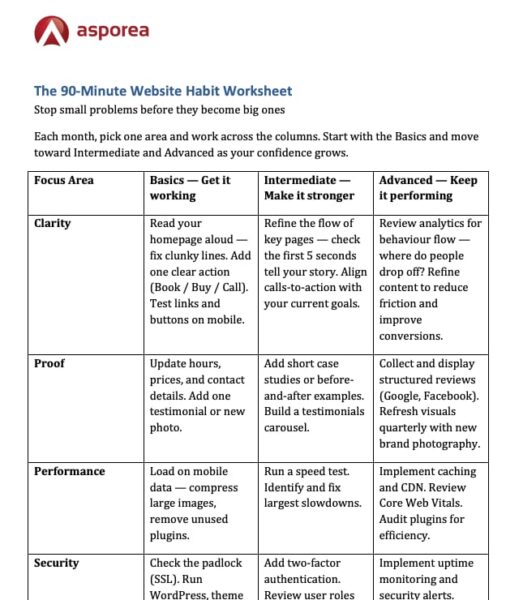
We’ve even got a worksheet of prompts you can use as your guide.
Don’t drown in dashboards. You only need three key numbers each month:
How long your homepage takes to load on mobile.
How many enquiries, bookings or sales came through.
How many visitors completed your main action.
Write them down in a notebook or spreadsheet. It’s not about being a data analyst. It’s about seeing trends. Over time you’ll notice that small tweaks lead to steady improvement, and that’s where the real motivation lives.
One local tradesperson told us they thought updates didn’t matter until they saw their enquiry rate double after fixing a slow-loading form. The change took ten minutes. The impact lasted all year.
After each check-in, write a short note about what you changed and why.
It might sound basic, but when something breaks that record becomes your lifesaver. You’ll know what was done, when and by whom.
A clear change log also helps you communicate with whoever manages your site or hosting. Instead of saying “the website’s weird again”, you can say, “We updated the booking plugin on Friday, and that’s when the issue started.” That’s the difference between a one-hour fix and a one-day hunt.
We’ve built a simple 90-Minute Website Habit Worksheet to guide you through each step.
It’s practical, clear and built for busy business owners who just want their website to work.

Turn your reflections into clear, practical goals for 2026 with a simple framework and an easy worksheet.

Stop getting silence after you hit send. Use an AI Assisted Automated Response that reflects the enquiry and buys time properly.

DIY Squarespace can look cheap, but hidden costs, owner time and growth limits can make WordPress the smarter long-term choice.