
Performance and Systems

Why Does Email Get More Expensive Without Getting Better?
As email lists grow, pricing increases and platforms become harder to use, even though the work stays the same. This article looks at why that

Local support is defined as the network of nearby people, organisations, and services that help a business grow, stay stable, and remain connected to its community. For small business owners and service providers, understanding why local support is important is not a soft consideration. It is a practical business decision with measurable consequences for credibility, resilience, and long-term growth.
Local chambers of commerce, community networks, and nearby service providers offer something that remote or national services cannot replicate: genuine knowledge of your specific market, your customers, and your operating conditions. That knowledge shortens learning curves, reduces costly mistakes, and builds the kind of trust that wins repeat business. This article explains the real advantages of community support and how you can put them to work.
Local communities and chambers of commerce reduce startup risks by providing mentorship, shared workspaces, regulatory guidance, and referral networks that digital-only services cannot replicate. That is not a small advantage. For a new trade business or allied health provider in Canberra, a warm referral from a trusted local contact is worth more than any paid advertisement.
The practical benefits of local support systems include:
Local infrastructure and networks significantly shorten founder learning curves and improve early-stage success rates. That means less time spent on costly trial and error, and more time building a business that actually works.
Pro Tip: Join your local chamber of commerce within your first year of trading. The chamber SEO and member resources available through these organisations often include directory listings, event exposure, and referral opportunities that take years to build independently.

Strong community ties produce measurable mental health benefits. Social capital in communities provides independent mental health benefits linked to lower mortality and better cardiovascular health. For business owners who often work long hours in relative isolation, this is a serious consideration, not a feel-good extra.
Community cohesion acts as a buffer against depression by providing social bonds and access to practical help that mediates stress and builds psychological resilience. Social support reduces negative emotional reactions to stressors and strengthens coping skills. A sole trader dealing with a difficult client or a cash flow problem is far better placed to manage that stress when they have a trusted local network to call on.
The key insight from current research is about quality over quantity:
“Meaningful community belonging requires repeated local contact, investment, and participation. Active contribution strengthens both the community and personal well-being. Quality of belonging in one or two genuine local communities benefits mental health more than superficial participation in many.”
Source: Simply Psychology, 2026
The practical implication for business owners is clear. Attending the same local networking event consistently, getting to know your neighbouring businesses by name, and contributing to local causes builds the kind of belonging that actually protects your mental health. Spreading yourself across dozens of online communities does not produce the same result.
Local support creates economic resilience by keeping money circulating within the community and by providing the kind of contextual knowledge that prevents expensive mistakes. When you hire a local web agency, accountant, or IT provider, a greater share of that spend stays in the local economy. That money pays local wages, funds local suppliers, and supports local services. The multiplier effect is real and cumulative.
Local providers act as unofficial consultants who understand regional market conditions and operational rhythms unavailable to national or remote services. A Canberra-based web provider knows that ACT government procurement cycles affect when local consultants are busy, that the Canberra market responds differently to pricing signals than Sydney or Melbourne, and that local search behaviour has specific patterns worth building around. A national provider simply does not carry that knowledge.
The table below contrasts what local and remote support typically deliver across the factors that matter most to small business owners.
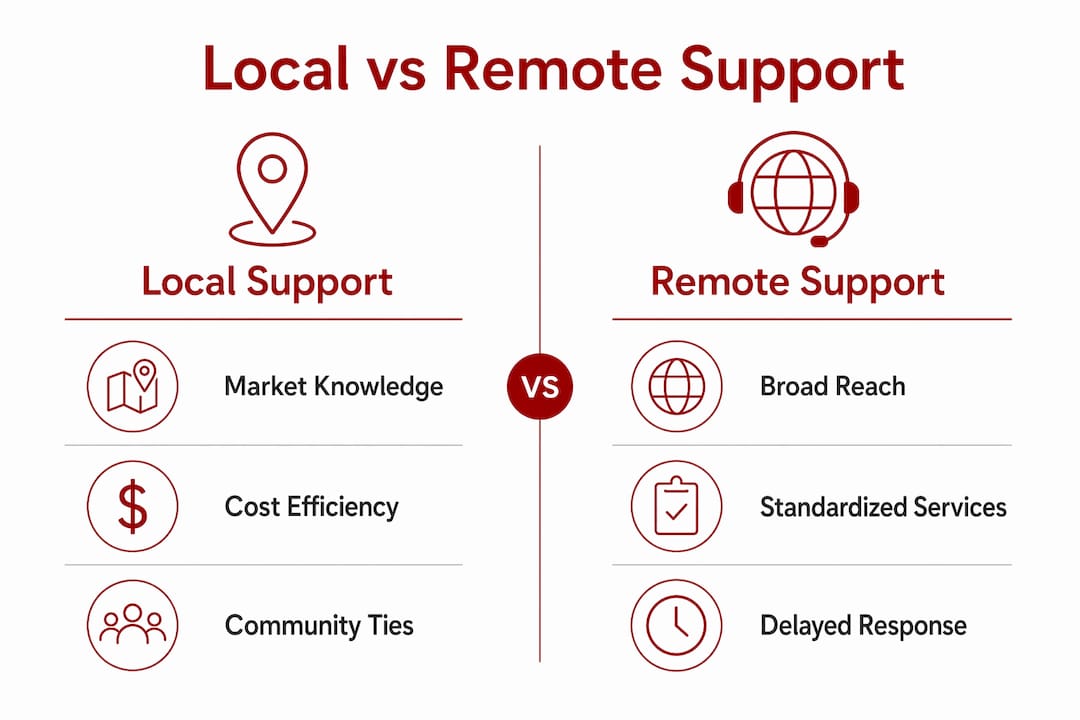
| Factor | Local support | Remote or national support |
|---|---|---|
| Market knowledge | Deep understanding of regional conditions and customer behaviour | Generic advice based on national averages |
| Response time | On-site visits possible; faster resolution of physical issues | Dependent on ticketing systems and time zones |
| Relationship depth | Ongoing, personal relationship with your specific situation | Account-managed or anonymous support queues |
| Cost predictability | Proactive upgrades aligned with your setup; fewer emergency costs | Standard packages that may not fit your infrastructure |
| Community investment | Spend recirculates locally and builds mutual goodwill | Revenue leaves the local economy |
Local support avoids emergency spend traps by staging predictable upgrades aligned with existing setups, unlike standard scalable solutions from national providers. That means fewer rushed hardware replacements, fewer sudden failures, and fewer situations where you are paying premium rates to fix something that should have been caught earlier.
Pro Tip: When evaluating any service provider, ask specifically whether they have other clients in your suburb or industry. A provider with genuine local experience will give you a concrete answer. One without it will give you a vague one.
Engaging with local support networks is a habit, not a one-off task. The business owners who benefit most from community support are the ones who show up consistently, contribute genuinely, and treat local relationships as long-term investments rather than quick wins.
Targeted support helps local actors solve problems uniquely suited to their knowledge of local social norms and conditions. That principle applies in both directions. When you support other local businesses, you strengthen the network that supports you.
Here are five practical steps to build and maintain strong local support connections:
The face-to-face web agency model reflects this principle directly. When your digital provider is local, they can sit across a table from you, understand your business in context, and give advice that is specific to your situation rather than drawn from a generic playbook.
Local community engagement and a strong digital presence work together. One without the other leaves gaps that cost you enquiries and credibility.
Asporeadigital builds fixed-price WordPress websites for small businesses in Canberra and the ACT, with a focus on sites that load quickly, work on mobile, and help local businesses win more enquiries. Every project is scoped clearly, built around your business outcomes, and supported by a Canberra-based team that understands the local market. From website design and branding to ongoing care plans and local SEO, Asporeadigital gives you one local contact who handles it all. If you want a website that supports your community presence and converts local traffic into real leads, website support for Canberra businesses is the practical next step.
Local support builds credibility, reduces costs, and protects mental health in ways that remote services cannot replicate, making it a core business asset for any small operator.
| Point | Details |
|---|---|
| Local networks reduce risk | Mentoring, referrals, and shared infrastructure shorten learning curves and improve early-stage success. |
| Community ties protect mental health | Consistent local engagement builds social capital that reduces stress and strengthens resilience. |
| Local providers prevent costly emergencies | Proactive, relationship-based support avoids rushed fixes and aligns upgrades with your actual setup. |
| Quality of belonging matters | One or two genuine local connections benefit your well-being more than many superficial ones. |
| Digital presence amplifies local support | Local SEO and a professional website extend your community credibility to online audiences. |
Local support refers to the network of nearby organisations, service providers, and community connections that help a business grow and stay stable. This includes chambers of commerce, local mentors, referral networks, and nearby service providers who understand your specific market.
Local spending recirculates within the community and creates a multiplier effect that strengthens the local economy. Local providers also reduce emergency costs by offering proactive, relationship-based service aligned with your existing setup.
Research confirms that social capital built through genuine local participation links to lower mortality, better cardiovascular health, and reduced depression risk. Quality of involvement matters more than quantity.
Join your local chamber of commerce, attend community events consistently, and support neighbouring businesses publicly. Relationships built steadily over time produce stronger referrals and goodwill than one-off networking efforts.
Meaningful belonging requires repeated face-to-face contact and genuine investment. Local relationships carry social proof and contextual knowledge that online communities cannot replicate, particularly for credibility with local customers.

As email lists grow, pricing increases and platforms become harder to use, even though the work stays the same. This article looks at why that

Stop getting silence after you hit send. Use an AI Assisted Automated Response that reflects the enquiry and buys time properly.

Build your online profile early to turn experience into coaching, courses, mentoring and new income before you need it fast.