
Blog

How EOFY Can Drive More WooCommerce Sales
EOFY buying has its own psychology. Learn how small businesses can use WooCommerce to turn timing, confidence and clarity into sales.

When a small business owner says, “I’ll just do the website myself”, it’s usually rational. Budgets matter. Time is tight. DIY websites feel like the fastest path to something live.
So let’s treat this like a business decision, not a design debate. DIY websites are absolutely possible to build. However, the real question is what it costs to make one work properly, keep it working, and avoid paying twice.
DIY websites can be a smart move when you need a placeholder, you’re testing a new offer, or you simply need basic credibility quickly. In other words, if you can accept “good enough for now”, building it yourself is a practical step.
That said, the problems start when you expect a self built site to perform like a professional lead generator.

DIY websites usually have a smaller invoice. Even so, the spend turns up elsewhere: your time, your attention, and the momentum you lose in the business. You don’t just publish a site and move on. Instead, you end up tweaking, fixing, second guessing, and learning tools you never wanted to learn.
And because that work rarely happens in the quiet hours you don’t care about, it tends to land in nights and weekends.
When DIY websites become an after hours project, they compete with family time and downtime. That’s the real trade. Not money versus money. Money versus life.
What’s more, because these builds often drag on, it’s not one weekend. It’s the ongoing “I’ll finish it soon” running in the background for months.
The hardest part isn’t the platform. It’s the judgement calls. For example, what goes on the homepage, what order services appear in, where proof belongs, what the call to action should say, and what to remove.
Meanwhile, a page builder can’t tell you which message will land, which layout will convert, or what trust signals your customers need before they enquire.
Most DIY websites aren’t ugly. They’re unclear. Visitors arrive, can’t quickly work out what you do or why you’re the right choice, and then they leave.
Usually, that comes down to structure, messaging, and flow. The design might look professional. Yet the performance doesn’t match.
Sooner or later, most DIY websites hit a point where progress stalls. You run into technical issues you can’t resolve quickly, and then the extra costs begin. A plugin conflict. A broken layout on mobile. A slow site that won’t speed up. Forms that stop sending. Tracking that never got set up properly. An update that changes everything.
At that point, DIY often stops and a specialist gets called in.
When we step into a site that’s been built in stages, we can’t just “continue”. First, we have to diagnose: what theme is controlling what, what plugins run core functions, what’s been customised, and what’s fragile.
As a result, you pay for reverse engineering before you pay for improvement. And since that diagnosis takes time, it costs money.
Sometimes the honest call is a rebuild. Not because anyone wants to start again, but because patching a shaky base can cost more than replacing it.
Paying a professional is about choosing the most cost effective route to a site that earns enquiries.
A professional build gives you a clear plan, structure that supports decisions, and messaging that makes your offer obvious. Plus, it delivers a site that behaves properly on mobile, loads as it should, and is tested before launch.
Most importantly, it removes the hidden tax: your nights, weekends, and mental bandwidth.
DIY websites are only cheaper if your time is worth nothing and lost leads don’t matter. Otherwise, you’re still paying, just in different currency.
If the website needs to bring in work, the cheaper option is usually the one you only pay for once.
Tell Asporea Digital what you do, who you serve, and what you need the website to achieve. Then we’ll tell you whether DIY is sensible for your stage, or whether it’s smarter to bring in a designer now and avoid the rescue job later.

EOFY buying has its own psychology. Learn how small businesses can use WooCommerce to turn timing, confidence and clarity into sales.
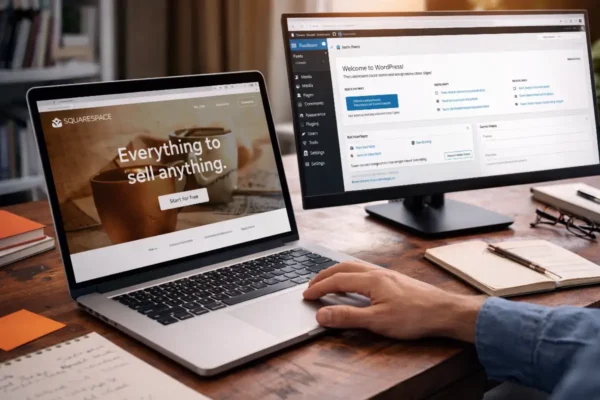
Outgrowing Squarespace? Learn why starting on the right platform can save you from a rebuild later and support long-term growth.

Many Canberra businesses think they own their domain name when they don’t. Learn how to protect your brand and keep control of your website with